
New Voting Rules Could Shape Turnout in Closely Contested Midterms
Sandego.net – Voters heading to the polls for November’s midterm elections will face a changing set of requirements in many parts of the country, with new state and local rules affecting registration, identification, mail ballots, early voting access and polling locations.
In Tarrant County, Texas, which sits within a pivotal swing district, people eligible to vote by mail will now have to include either a Social Security number or state identification number. In-person voters will also see a substantially different map of polling locations: nearly 100 sites have been closed, including every location in a ZIP code with a largely Black and Latino population.
The Texas changes are part of a broader trend. Since the 2022 midterm election, Republican officials in numerous states and counties have approved measures that add voting requirements or reduce places and opportunities to cast a ballot. The changes range from more demanding registration rules and expanded ID requirements to fewer early-voting locations, ballot drop boxes and Election Day polling sites.
Although national debate has often focused on President Donald Trump’s efforts involving mail voting and voter rolls, county-level and state-level decisions may also influence participation in races that will determine control of Congress.
Competitive races and new barriers
At least 22 states have introduced new obstacles for voters compared with the 2024 election. Those measures add to a larger wave of restrictions: 30 states enacted at least 78 restrictive voting laws between 2020 and 2024.
The impact could be especially significant in battleground contests. Competitive Senate elections are underway in Iowa, Ohio, North Carolina and Texas, while closely divided House races could help determine whether Democrats gain the three seats needed to take the House. Democrats would need four Senate seats to secure control of that chamber.
Voting-rights advocates contend that the combined effect of these rules can be substantial, particularly for people navigating the process for the first time, voters without driver’s licenses, older adults and some disabled voters.
“Many states are emulating the president’s agenda at the state level,” in ways that affect “whether eligible voters have a clear accessible path to cast a ballot,” said Celina Stewart, CEO of the League of Women Voters.
“In 17 years of working on voting rights, I have never seen such a widespread and coordinated effort to restrict access to the ballot.”
Republican supporters of the new laws argue that stronger rules are necessary to protect election integrity. That argument frequently echoes Trump’s claims of widespread voter fraud, claims that have been repeatedly disproven.
Texas Gov. Greg Abbott highlighted his state’s approach during the Republican midterm convention in August.
“The toughest voter ID law in the United States of America,” Abbott said Texas had adopted, adding: “We made clear that in elections in Texas, you have to be a United States citizen to vote.”
There is no evidence that non-citizens have voted in Texas or elsewhere in numbers large enough to affect elections.
Tarrant County’s polling-place dispute
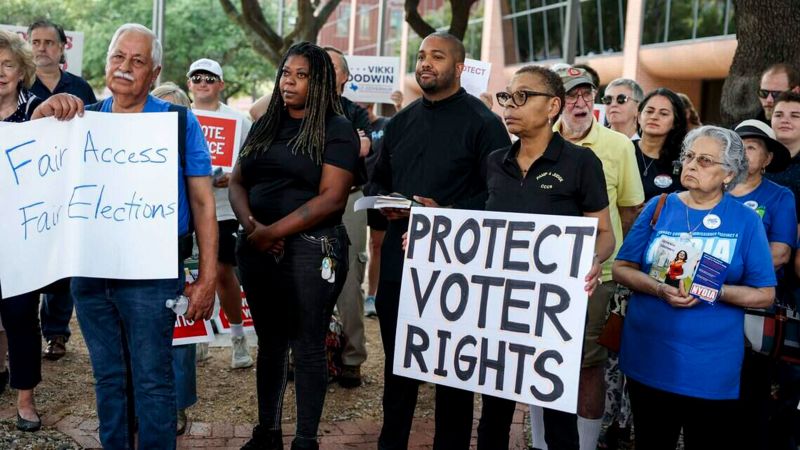
The decision in Tarrant County has drawn sharp criticism from residents and voting advocates. On September 1, as demonstrators gathered outside, the Republican-controlled commissioners court voted 3-2 on party lines to cut the county’s number of polling sites by almost 30%.
County Judge Tim O’Hare said reducing the number of sites was intended to save money. Critics responded that the closures could disproportionately burden communities viewed as more likely to support Democratic candidates, especially where transportation, work schedules or long travel distances can make voting more difficult.
At a county meeting before the vote, speaker after speaker urged commissioners not to eliminate polling locations. The dispute illustrates how administrative choices can affect access even when the formal right to vote remains unchanged. A voter may still be eligible, but a longer trip, a crowded location or fewer available hours can make casting a ballot more difficult in practice.
“Jane and Jim Crow are very much alive in Texas today,” said Brianna Brown, executive director of the Texas Organizing Project.
“In Texas, the demographics of young people and black and brown people are increasing, so the GOP is looking at ways to shrink participation.”
Brown noted that Black and Hispanic Texans together constitute a majority of the state’s population.
Ohio prepares for a stricter ID system
Ohio voters will confront another major change for the first time in a midterm election. The state’s 2023 law, passed by the Republican-controlled legislature, establishes one of the country’s strictest voter identification systems.
The law requires voters to present photo identification. Ohioans can no longer rely on digital IDs, paychecks or other documents for identification or proof of residency at the polls. New voters also face narrower options for the documents they may use when registering.
Other provisions shortened the period for requesting absentee ballots and reduced the time available to correct mistakes on those ballots. Such deadlines can matter when a voter’s application is delayed, a form is incomplete or an identification detail does not match election records.
The timing is consequential in Ohio, where Republican Sen. Jon Husted is in a close Senate race with former Democratic Sen. Sherrod Brown. The state also has several important House contests.
For voters, the practical takeaway is straightforward: checking registration status early, confirming the required form of identification and reviewing local polling-place information can prevent last-minute surprises. In jurisdictions where sites have closed or voting procedures have changed, election participation may depend as much on preparation as on a voter’s willingness to cast a ballot.
Related Reading
Frequently Asked Questions
What is GOP controlled local boards restrict voting?
GOP controlled local boards restrict voting is the main topic of this guide. The article explains the context, practical details, and next steps readers should understand.
Why does GOP controlled local boards restrict voting matter?
GOP controlled local boards restrict voting matters because readers are looking for a useful answer, not just a short summary. Good content should match search intent and help them decide what to do next.