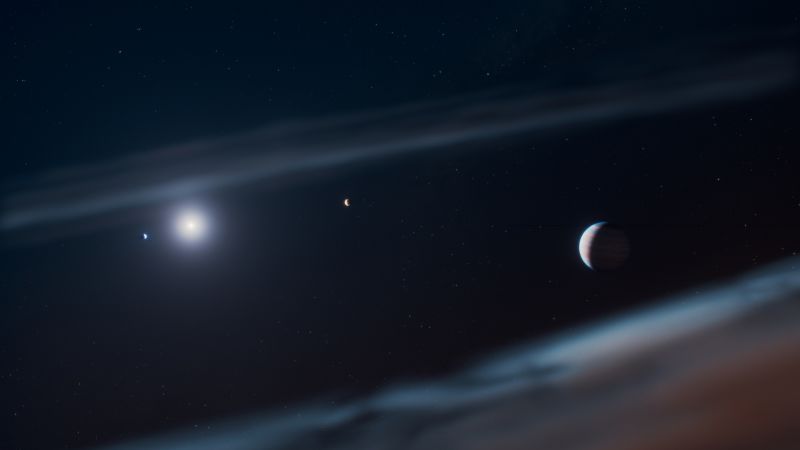
Radio Bursts From Beta Pictoris b Point to Powerful Planetary Magnetic Field
Sandego.net – Astronomers have identified what appears to be the first direct radio emission detected from a planet beyond the solar system, opening a new way to investigate distant worlds that cannot be examined in detail by conventional imaging alone.
The repeating bursts are linked to Beta Pictoris b, a massive gas giant roughly 63 light-years away. While radio signals can evoke thoughts of extraterrestrial intelligence, the newly identified emission has a natural explanation: intense auroral activity driven by an exceptionally strong magnetic field.
“I know radio signals are associated with searches for extraterrestrial intelligence,” said Edo Berger, a professor of astronomy at Harvard University. “But this is something very different.”
The findings are described in a study posted September 15 on the ArXiv preprint platform and awaiting publication in a peer-reviewed journal. Researchers believe the radio waves originate in processes connected to the planet’s magnetic environment, much like radio emissions produced by auroras in the solar system.
A magnetic field far stronger than Jupiter’s
Beta Pictoris b is about 12 times as massive as Jupiter and orbits a young star that is approximately 1.75 times the mass of the sun. The planet is one of three known worlds in the Beta Pictoris system.
The signal’s detected frequencies indicate an extraordinary magnetic field. Berger said the field surrounding Beta Pictoris b is at least 200 times stronger than Jupiter’s. That comparison is striking because Jupiter already has the most extensive magnetosphere in the solar system. Its magnetic influence can extend as far as 2 million miles, or 3 million kilometers, in the direction of the sun.
“In order to see radio waves that extend all the way to the frequencies that we observed, you need an incredibly strong magnetic field,” Berger said.
Magnetic fields can be crucial to a planet’s environment. On Earth, the magnetic field helps protect the atmosphere from the solar wind, a stream of plasma carrying charged particles such as protons and electrons. Not every planet has this kind of shield, and the strength and structure of a magnetic field can offer clues about a world’s interior and atmosphere.
For exoplanets, these measurements are especially valuable. Distant planets are often known through their effects on host stars or through observations of light passing through their atmospheres. Radio astronomy could provide a separate route for studying their magnetic properties.
“Radio observations can give us a completely new view on planets beyond our system,” Berger said.
Auroras beyond the solar system
The proposed explanation centers on auroras, the same broad family of phenomena that produces the northern and southern lights on Earth. Auroras occur when charged particles interact with magnetic fields and atmospheric gases. At Beta Pictoris b, the scale of that activity is expected to be far more extreme than the familiar displays visible near Earth’s poles.
Jupiter provides a useful nearby example. Charged material from volcanic eruptions on its moon Io becomes caught within Jupiter’s magnetic field, particularly near the planet’s poles. As Jupiter rotates, high-energy particles spiral through the field, producing visible auroras as well as radio waves.
Astronomers refer to these signals as auroral radio emissions. Similar emissions have been observed from Jupiter, Saturn and the sun. They have also been found around stars beyond the solar system and brown dwarfs, objects that occupy a middle ground between planets and stars.
The apparent detection at Beta Pictoris b stands out because researchers were able to separate the emission from the planet itself rather than merely finding a radio source somewhere near the star.
Joseph Callingham, an associate professor at the Anton Pannekoek Institute for Astronomy at the University of Amsterdam, said earlier hints of radio emission from exoplanets had not been confirmed because the host star could not be excluded as the source.
“What is unique for this study is that they localise the emission to the planet itself, separate from the star,” Callingham wrote in an email.
A young system under close observation
The Beta Pictoris system is an especially compelling setting for this discovery because it is remarkably young on astronomical timescales. It is estimated to be about 23 million years old, compared with the solar system’s age of roughly 4.5 billion years.
Beta Pictoris b was discovered in 2008. Two more planets in the system, Beta Pictoris c and Beta Pictoris d, were identified in 2019 and 2026. The system has become one of the most closely studied planetary neighborhoods in the galaxy.
Its central star is known to host 30 orbiting comets and is surrounded by a vast disk of dust and debris. NASA’s Hubble Space Telescope captured detailed views of that disk in 2015. Some of the material circling the star is leftover debris from the era of planet formation, making the system a useful natural laboratory for examining how young planetary systems develop.
The radio detection adds another layer to that picture. A magnetic field can influence the movement of charged particles around a planet, shape auroral activity and help scientists assess physical conditions that are otherwise difficult to measure across interstellar distances.
Further observations will be needed to strengthen the case and to determine how common auroral radio signals may be among exoplanets. Still, the result suggests that radio telescopes may become increasingly important in the effort to understand worlds outside the solar system—not by searching for a message, but by listening to the powerful natural processes unfolding around them.
Related Reading
Frequently Asked Questions
What is Radio signal detected from exoplanet?
Radio signal detected from exoplanet is the main topic of this guide. The article explains the context, practical details, and next steps readers should understand.
Why does Radio signal detected from exoplanet matter?
Radio signal detected from exoplanet matters because readers are looking for a useful answer, not just a short summary. Good content should match search intent and help them decide what to do next.