Heidenau Vote Sparks Anger Over Holocaust Memorial Plaques
Sandego.net – A decision in the eastern German town of Heidenau to block additional Holocaust memorial plaques has prompted sharp criticism from Jewish representatives, artists and political opponents. The town council near Dresden, in the state of Saxony, approved a proposal preventing further installation of Stolpersteine, the small brass markers placed at locations connected to people persecuted by the Nazis.
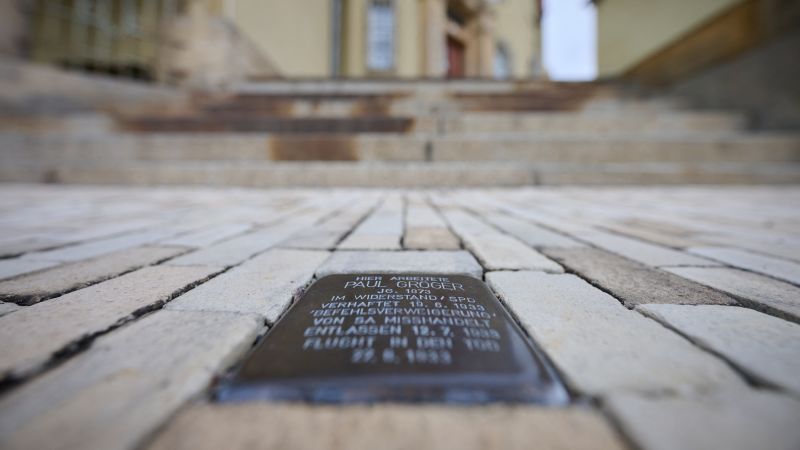
Stolpersteine, commonly translated as “stumbling blocks,” are embedded in pavements outside former homes or workplaces. Each 10-centimetre brass cube records details of an individual victim, typically including a name, deportation date and place of death. Their purpose is to bring remembrance out of museums and cemeteries and into ordinary streets.
Heidenau’s council supported a motion put forward by local branches of the far-right Alternative for Germany, or AfD, and the centre-right Christian Democratic Union, or CDU. Supporters argued that people may walk across the plaques or step directly on victims’ names. They proposed concentrating future Holocaust remembrance at the memorial area in the town’s northern cemetery.
A Memorial Designed for Everyday Life
Critics say the reasoning overlooks the central idea behind the Stolpersteine project. The plaques are deliberately modest and placed in the places where persecuted people once lived, worked and belonged. Encountering one unexpectedly can interrupt a routine walk and connect a present-day street with an individual life destroyed under Nazi rule.
German artist Gunter Demnig began the initiative in the 1990s. It has since become one of Europe’s largest decentralized memorial projects, with 116,000 plaques installed in 31 countries. Most are located in Germany, where the markers commemorate Jews as well as other groups targeted by Nazi persecution.
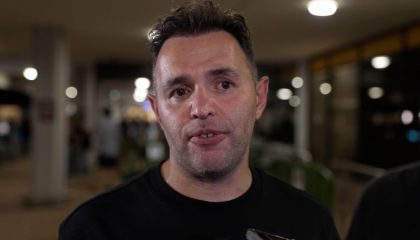
Demnig rejected Heidenau’s decision and emphasized that the markers need to remain at the real sites associated with victims’ lives. He said their presence can make history more immediate for younger generations. He also said the ban did not surprise him in light of the AfD’s recent electoral gains.
“[The CDU] should perhaps drop its ‘C’. Because they’ve clearly left Christianity behind.”
The project has faced debate before, including from people who are uncomfortable with names being placed underfoot. Yet supporters maintain that the plaques’ street-level placement does not diminish victims; rather, it restores their visibility in communities from which they were forced out.
Political Fallout Beyond a Local Decision
Felix Banaszak, co-leader of Germany’s Green Party, called the vote a scandal and dismissed the argument about people stepping on the markers.
“They bring the names and fates of the victims into our everyday lives and prompt us to pause for a moment.”
Charlotte Knobloch, a Holocaust survivor and president of a Jewish association in Bavaria, also condemned the council’s choice. Although she said she was not personally a supporter of the Stolpersteine concept, she stressed the importance of remembrance that remains present in public space rather than being removed from it.
“Decentralized commemoration that is not banished from public spaces” is key for the country’s culture of remembrance.
The dispute has widened because the measure passed with backing from both AfD and CDU representatives. In German politics, mainstream parties have generally upheld the Brandmauer, or firewall, an informal commitment to avoid cooperation with the AfD. The principle is intended to keep the far right from influencing political decisions and to limit its ability to expand its role in government.
For critics, the Heidenau vote illustrates how that firewall is being tested at the municipal level. CDU participation in the measure has drawn criticism at a difficult moment for Chancellor Friedrich Merz, who leads the CDU and is already under pressure after weak results in recent regional elections.
Debate Over Germany’s Culture of Remembrance
The AfD has repeatedly challenged established forms of remembrance for crimes committed under Adolf Hitler’s regime. In Saxony-Anhalt, where the party recently achieved its strongest state-election result, a prominent AfD figure outlined a desired change to history teaching with the phrase “more Bismark – less Hitler.”
At the federal level, German domestic intelligence designated the party a far-right extremist organization, though the designation is currently being reviewed. Individual AfD members have also faced accusations of extremism.
For many opponents of the Heidenau ban, the dispute is therefore about far more than the placement of brass cubes in a pavement. It concerns who is visible in public memory, where the history of Nazi persecution should be recalled, and whether remembrance can be shifted away from the places where victims once built their lives.
The International Auschwitz Committee condemned CDU support for the proposal. Its executive vice president described the move as an effort to push Nazi victims out of Heidenau once again and confine their memory to a cemetery.
“This is a transparent and despicable attempt to drive Nazi victims in Heidenau out of the city once again and dispose of them where, according to the AfD, their memory has belonged a long time ago — at the cemetery.”
As the controversy continues, Heidenau has become a focal point in Germany’s broader argument over public remembrance. The Stolpersteine may be physically small, but their placement carries a larger message: the people named on them were part of the everyday fabric of towns and cities, and their absence should not be made easy to overlook.
Related Reading
Frequently Asked Questions
What is Outrage as East German town bans?
Outrage as East German town bans is the main topic of this guide. The article explains the context, practical details, and next steps readers should understand.
Why does Outrage as East German town bans matter?
Outrage as East German town bans matters because readers are looking for a useful answer, not just a short summary. Good content should match search intent and help them decide what to do next.