
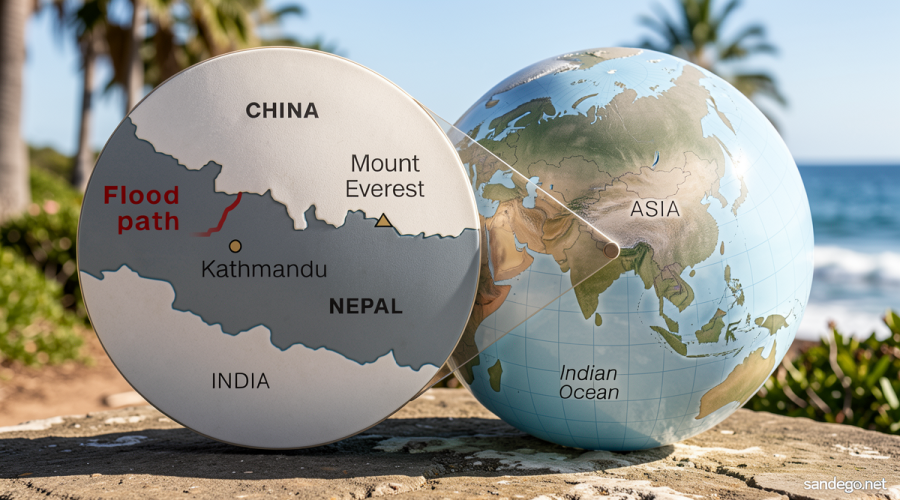
Monsoon Fury at the Nepal-China Border Leaves Over 1,200 Dead and Thousands Missing
Sandego.net – The Himalayan footholds along the Nepal-China frontier have been battered by a convergence of catastrophic flash floods and enormous landslides that, over the course of last week, obliterated entire settlements, severed critical transportation links, and claimed the lives of more than 1,200 people. The disaster struck during the peak of the South Asian monsoon, when sustained rainfall saturates already-unstable mountain slopes and sends rivers surging far beyond their banks. In the aftermath, more than 4,500 residents across both countries remain unaccounted for, a figure that continues to grow as communication lines stay severed and access roads stay buried under debris.
A Landscape of Total Destruction
Satellite imagery captured in the days following the event reveals the staggering geographic footprint of the catastrophe. Villages that had existed for generations now appear as flat scars of mud and shattered timber. Bridges spanning the Trishuli River and its tributaries — structures that often serve as the sole connection between isolated hillside communities and the nearest hospital or market — have been swept away entirely. Houses built on steep gradients slid downhill along with the soil beneath them, leaving behind exposed bedrock and tangled wreckage.
The simultaneous occurrence of flooding and slope failure multiplied the damage far beyond what either hazard alone would have produced. Waterlogged earth loses its shear strength, and when monsoon rains deliver hundreds of millimetres of precipitation within a single day, entire hillsides can liquefy and cascade into river valleys below. In the eastern districts bordering China, where the terrain drops sharply from high-altitude plateaus into narrow gorges, this process is especially violent and leaves little time for evacuation.
Hydropower Workers Stranded Along the Trishuli
Among those missing are roughly 940 workers employed at various hydropower projects situated along the Trishuli River, a figure supplied by Nepal’s Independent Power Producers’ Association (IPPAN). The Trishuli basin, a major tributary of the Ganges system, has become one of the country’s most active corridors for large-scale hydroelectric development. Construction camps, access roads, and temporary worker housing line the river’s course, placing hundreds of labourers directly in the path of floodwaters and debris flows.
Nepal’s economy depends heavily on hydropower exports, particularly to India, and the sector represents a substantial share of foreign-currency earnings and rural employment. A disaster that halts multiple projects simultaneously — whether through physical destruction of infrastructure, loss of workforce, or prolonged inaccessibility of sites — carries implications that extend well beyond the immediate human toll. Contractual deadlines, financing covenants, and seasonal construction windows all compress when work stops for weeks or months, creating cascading financial pressure on developers, lenders, and the national grid.
Why August Is the Most Dangerous Month
The timing of this disaster is not accidental. August sits at the heart of the monsoon season across the Indian subcontinent and the eastern Himalaya. Warm, moisture-laden air masses from the Bay of Bengal collide with the windward slopes of the Himalayan range, producing some of the highest rainfall totals recorded anywhere on Earth. In the high-altitude border zones between Nepal and China, where annual precipitation can exceed 3,000 millimetres, even a single day of extreme rainfall can trigger multiple simultaneous slope failures within a narrow valley.
The geological setting compounds the risk. The Nepal-China border traverses young, actively folding mountain terrain where rock layers are fractured, soils are thin and poorly consolidated, and drainage networks are dense but shallow. Decades of road-building, dam construction, and timber extraction have further destabilised slopes that were already marginal. Each successive monsoon season therefore finds a landscape more primed for failure than the last.
Rescue in Near-Impossible Terrain
Reaching the hardest-hit areas presents logistical challenges that dwarf those faced in flat-land disasters. Many affected villages are accessible only by footpaths or single-lane mountain roads, both of which have been severed by debris. Helicopter operations — the primary means of rapid access in such terrain — are constrained by low cloud cover, strong crosswinds in narrow valleys, and the absence of suitable landing sites once structures have collapsed. Every additional day of isolation increases the risk of secondary landslides, contamination of water supplies, and the onset of waterborne disease among displaced populations.
For the families of the more than 4,500 missing persons, each passing hour deepens uncertainty. Local authorities in both countries have mobilised search-and-rescue teams, but the sheer scale of the affected area — stretching across multiple districts on both sides of the border — means that systematic comb-through of debris fields will take weeks. International aid agencies have begun coordinating relief shipments, though delivery remains bottlenecked by the same infrastructure failures that caused the disaster.
What Comes Next
As the immediate emergency phase gives way to assessment and recovery, questions will mount about preparedness. Did early-warning systems along the Trishuli basin trigger timely evacuations? Were construction sites required to maintain adequate floodplain setbacks? Can the pace of hydropower expansion be reconciled with the geological reality of the mountains it traverses? These questions will shape policy debates in Kathmandu and Beijing in the months ahead, but for the families now waiting for news of missing relatives, the only question that matters is whether anyone is still alive beneath the rubble.
Related Reading
Frequently Asked Questions
What is Landslides and floods have wreaked havoc?
Landslides and floods have wreaked havoc is the main topic of this guide. The article explains the context, practical details, and next steps readers should understand.
Why does Landslides and floods have wreaked havoc matter?
Landslides and floods have wreaked havoc matters because readers are looking for a useful answer, not just a short summary. Good content should match search intent and help them decide what to do next.