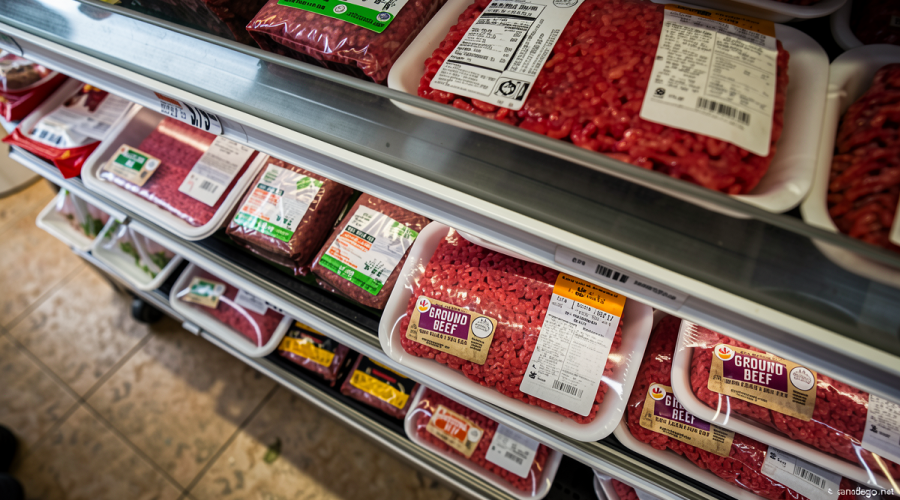
Trump Stands by Temporary Beef Tariff Pause as Rancher Backlash Builds
Sandego.net – President Donald Trump doubled down on his decision to temporarily suspend out-of-quota tariffs on imported ground beef on Friday, insisting the move is aimed squarely at easing pressure on grocery shoppers rather than undermining domestic producers. Speaking to reporters en route to South Carolina, the president offered no signal that the policy would be reversed once the 90-day window closes.
“We want to get the beef prices down, so we’ll get them down a little bit, and that’s what people want. That’s what the voters want, and that’s what I want.”
The announcement, made earlier in the day, permits up to 300,000 metric tons of ground beef to enter the United States tariff-free over the next quarter. Trump declined to name the exporting nations involved, describing them only as suppliers of “the highest quality beef” that the domestic market currently requires.
“I don’t want to say which countries, but there are a few countries, but they’re going to be sending in the highest quality beef, and it’s something that we need.”
Industry Pushback: “No Cow-Calf Producer Is Asking for This”
The National Cattlemen’s Beef Association, the largest trade group representing American beef producers, moved quickly to challenge the premise of the tariff pause. In a social-media statement, the association argued that no segment of the cow-calf sector had requested expanded imports and that flooding the market with foreign product would erode confidence rather than rebuild it.
“No cow-calf producer in America is asking for increased imports. Undercutting American farmers and ranchers with inferior product from foreign competitors does nothing to create market confidence or encourage rebuilding the herd.”
The association’s position reflects a broader anxiety among ranchers who have spent years trying to recover from a prolonged cattle-herd contraction. The U.S. cattle inventory currently sits at a multi-decade low, a condition driven by years of drought, elevated feed costs, and the lingering effects of the 2021–2022 screwworm outbreak that forced mass culls in the Southwest. In that context, even a temporary influx of cheaper imported beef can depress domestic cattle prices at exactly the moment producers need revenue to restock herds.
Congressional Alarm Bells
Republican senators from cattle states joined the industry in voicing alarm. Sen. Chuck Grassley of Iowa, whose district is heavily dependent on beef production, pointed to the closure of a Tyson beef processing plant in Joslin, Illinois, earlier that month as evidence that domestic supply chains are already under strain.
“After Tyson closure in Illinois last wk I’m concerned for the cattle markets +now Pres Trump’s decision to temporarily open up subsidized beef imports. USA cattlemen shld always be put 1st thru America 1st policies Need 2keep up progress fighting screwworm+ expanding domestic herd.”
Grassley’s post, compressed by X’s character limits, nonetheless captured the core objection: that opening the border to subsidized foreign beef at this juncture would compound existing market fragility rather than relieve it.
Sen. Tim Sheehy of Montana, another GOP voice from a major cattle state, went further, saying he had counseled the president against the move for roughly a year. Sheehy framed the issue as one of structural market power, arguing that packers have long squeezed ranchers and that imported beef would deepen that squeeze.
“I’ve advised President Trump against this course of action for a year because American ranchers have been struggling against the packer monopoly for decades, and this will further harm them – most of whom are MAGA Republicans.”
Sheehy acknowledged the administration’s consumer-price objective and noted that screwworm-related disruptions were already pushing prices upward. Yet he warned that the tariff pause would make it harder for ranchers to rebuild herds and, ultimately, to deliver the very price relief the president seeks.
“But the reality is this action will make it more difficult for American ranchers to rebuild our herd and bring prices down for the American people. And most importantly, this will harm our ranching families who feed the nation.”
White House: A Short-Term Fix, Not a Strategic Shift
A White House spokesperson pushed back on the characterization of the move as anti-rancher, stating that the administration had “repeatedly affirmed” its support for American farmers and ranchers. The spokesperson framed the tariff pause as a response to a short-term supply crunch while simultaneously noting that the administration was working with producers to expand herd size from its current multi-decade trough.
Deputy chief of staff Stephen Miller, pressed by reporters on Sheehy’s criticism, defended the administration’s record on rancher issues and pointed to USDA actions taken to protect the food supply chain. He stressed that the screwworm outbreak in Mexico had created an acute, localized disruption that warranted a targeted, time-limited response.
“No administration has been more pro-rancher than this administration taking extraordinary actions under USDA to protect and ensure the security of our food supply chain — but again, there’s been, there was an outbreak of screwworm in Mexico.”
Miller characterized the import window as “a specific, temporary deal to address an acute issue,” a framing designed to distinguish the policy from a broader trade-liberalization agenda.
What the Pause Means for Markets
The 300,000-metric-ton allowance, spread across 90 days, translates to roughly 3,300 metric tons per day of additional ground beef entering the domestic supply chain. For consumers, the effect should be a modest downward pressure on ground-beef prices at retail, particularly in the near term. For producers, the near-term effect is a price signal that can discourage restocking decisions at exactly the moment the herd needs to grow. The tension between those two outcomes is the central political fault line the administration now faces, and the absence of any stated sunset condition beyond the 90-day window leaves open the question of whether the pause will quietly extend once the initial import volume clears the market.
Related Reading
Frequently Asked Questions
What is Trump defends pause on beef tariffs?
Trump defends pause on beef tariffs is the main topic of this guide. The article explains the context, practical details, and next steps readers should understand.
Why does Trump defends pause on beef tariffs matter?
Trump defends pause on beef tariffs matters because readers are looking for a useful answer, not just a short summary. Good content should match search intent and help them decide what to do next.