Spain’s Sierra Morena loses its last wild child
Sandego.net – The remote hamlet of Rante, tucked into the hills of northwestern Spain, has lost the most extraordinary resident it ever hosted. Marcos Rodríguez Pantoja, the man who spent twelve years of his youth surviving alongside wolves in the Sierra Morena range, died last week at the age of 80. The local government of San Cibrao das Viñas confirmed the passing, closing a chapter that had drawn anthropologists, filmmakers, and curious readers from across the globe for more than two decades.
Those who knew Pantoja in his final years described a man who never fully re-entered the human world. Arturo Arcones, a close companion in Pantoja’s later life, offered a portrait that captured the essence of the man: a creature of the landscape itself, shaped by decades of solitude among peaks and valleys.
“He was a person made of earth, wind, air, rain, and hunting dens,” Arcones told Spain’s public broadcaster. “He always said that his happiest life was with the wolves, because he didn’t feel very comfortable with humans.”
A childhood severed by poverty and loss
Pantoja was born in 1946 in Añora, a small village in southern Spain’s Córdoba province, in a country still reeling from the devastation of civil war and the Second World War. Poverty defined the household from the start. After his mother died, his siblings were absorbed into extended family networks, but young Marcos remained with his father. The father remarried and relocated the household into the Sierra Morena mountains, where the family earned a precarious living producing charcoal.
Professor Gabriel Janer Manila, a philosopher at the University of Palma de Mallorca who later devoted years of research to Pantoja’s story, reconstructed the family’s descent into hardship. The stepmother, Manila’s account indicates, subjected the boy to abuse. At just seven years old, Pantoja was handed over by his father to an elderly goat herder — a transaction that effectively erased him from the records of settled society.
“They took me to the mountains, to a cave. A little old man with a beard came out wearing cork shoes,” Pantoja recalled in an interview with Manila, describing the moment his childhood ended and a wilderness existence began. “There were howling wolves, foxes, mountain goats, deer, scorpions, snakes. At night, I heard these animals and I was afraid.”
Twelve years in the pack’s orbit
The herder became Pantoja’s sole teacher. Under his tutelage, the boy learned to keep warm with animal pelts, to milk goats, and to hunt rabbits with nothing more than a sharpened stick. Manila, in his published study, described this phase as an initiation into what he called “the law of the jungle.” Pantoja understood he was different from the animals around him — “especially because he had hands,” Manila noted — yet he nonetheless felt embedded in their community.
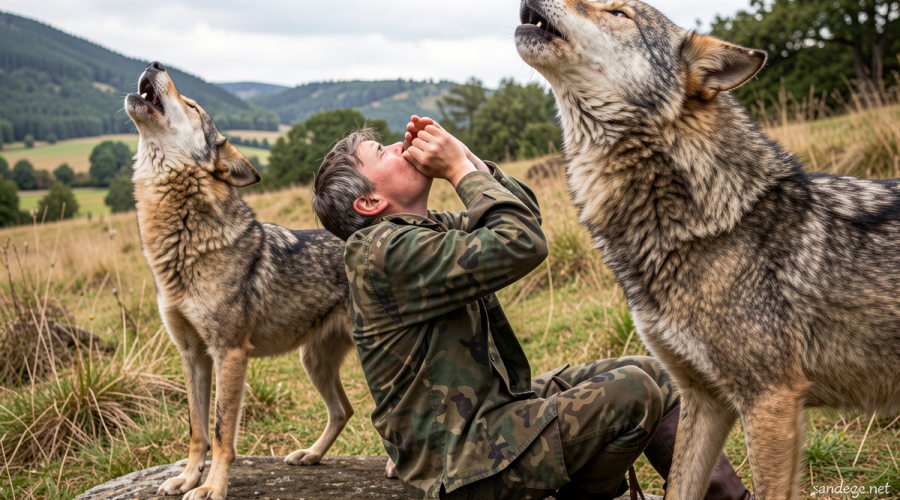
He mastered the vocal repertoire of the surrounding ecosystem: birdsong, the bleat of deer, the rustle of foxes. He believed he could communicate “effortlessly with foxes, wolves and even snakes.” When the herder vanished without explanation, Pantoja was left alone in a landscape that had already claimed his identity. Drawing on every skill the old man had imparted, he survived independently and, over time, earned the trust of a wolf pack by carrying food to their cubs and raising alarm howls whenever he sensed a threat.
“I was crying and they jumped up at me… then they showed me the way to their cave, the wolf’s den,” Pantoja told Manila, recounting the pups tumbling and leaping around him in greeting.
He avoided any trace of human presence, ducking into cover whenever voices carried across the ridgeline. That pattern held until 1965, when members of the Guardia Civil located him at nineteen, “lost and alone, among the ravines,” as Manila put it in his study.
The difficult return
Reintegration proved far harder than the wilderness had been. Those who encountered Pantoja in his first months back in society noted an acute intelligence of the natural world paired with what Manila described as a “wild character” and a “complete lack of awareness when it came to social life.” His speech carried gaps — particularly an inability to name ordinary objects — his gait was strange, and his naivety in human dealings was striking.
After his discovery, Pantoja lived under the care of a priest in the southern city of Jaén, then with nuns in Madrid. Following compulsory military service, he drifted to Mallorca, where he took work in hotels and restaurants. It was on the Balearic island that he crossed paths with the young anthropologist Gabriel Janer Manila, who became the first outsider to take the wolf-boy narrative seriously and to begin the long process of documenting it.
In a 2010 interview with a Spanish news programme, Pantoja reflected on those mountain years with a quiet pride:
“I was doing very well and I didn’t know what money was but I never lacked food. If I wanted to fish, I fished in the river. If I wanted a rabbit, I caught it. If I wanted a deer, I called to my parents who were the wolves. I let out a howl, I hid in the river and the wolves brought the cattle down to me.”
A life shared, a story told
Manila spent five months in sustained interviews with Pantoja for the philosophy department at the University of Palma de Mallorca. The resulting doctoral thesis was eventually published as a book titled I Played with Wolves, and a film adaptation, Among Wolves, carried the narrative to wider audiences.
In his final decades, Pantoja settled in Rante in 2001, sharing a home with a retired police officer. He devoted himself to telling his story publicly, Arcones explained, “with the intention of protecting nature and fostering a better understanding of it.” The Sierra Morena range, where charcoal burners once blackened the air and wolf packs still roam the higher slopes, lost its most improbable inhabitant. What remains is a life that no standard biography can contain — twelve years measured not in years but in howls, in the language of teeth and fur, in a boy who learned to belong to something older than any village.
Related Reading
Frequently Asked Questions
What is Spain s wolf boy of Sierra?
Spain s wolf boy of Sierra is the main topic of this guide. The article explains the context, practical details, and next steps readers should understand.
Why does Spain s wolf boy of Sierra matter?
Spain s wolf boy of Sierra matters because readers are looking for a useful answer, not just a short summary. Good content should match search intent and help them decide what to do next.