Trump’s ‘Very Special Stone’ White House Tour
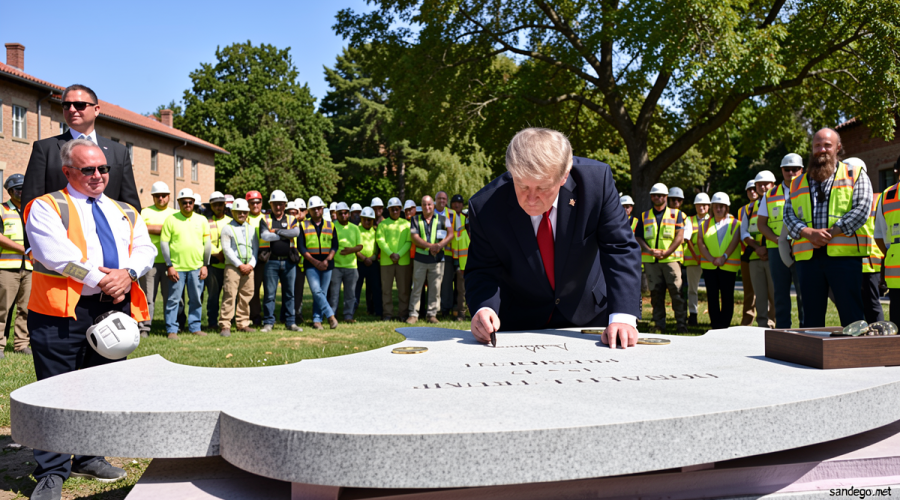
Sandego.net – President Donald Trump stepped off his scheduled itinerary on Wednesday to hand reporters an impromptu walking tour of two White House construction sites: a full driveway replacement and the still-unfinished presidential helipad. It was his second informal build-site walkthrough with the press corps this year, and it underscored how personally he manages decisions that other presidents would hand to facilities managers — down to stanchion-post angles and the radial grain of each cut slab. The centerpiece of his commentary was what he repeatedly called a “very special stone,” the California-quarried white granite now paving the mansion’s main approach.
Driveway Replacement and the Granite Upgrade
The driveway project had not been publicly announced before Wednesday. Trump walked the freshly laid surface and explained the rationale for ripping out decades of asphalt.
“This was always asphalt, which is very basic, not appropriate for a great house — for a great place like the White House,” he said, gesturing at the ground beneath his feet while construction noise clanged behind him.
The replacement material, which he labeled a “very special stone,” eliminates the potholes that had accumulated over years of heavy vehicle traffic and restores a uniform, polished finish to the approach. He stressed that the upgrade was both aesthetic and structural, removing a surface that had deteriorated beyond repair.
Helipad Grade Dispute and the “Dead Flat” Fix
Helipad work began shortly after Trump’s UFC appearance in June. Weeks into the build, crews were spotted dismantling sections of the platform — a reversal the White House had previously declined to explain. On Wednesday the president supplied his own account: he had been unhappy with the surface grade.
“I felt it was too much slope. It’s a slope for the rain, but I felt it was too much slope,” Trump said, announcing the platform was now “dead flat.”
Addressing workers nearby, he acknowledged the disruption the change caused.
“Sorry to take an extra week-and-a-half, but lifting it up was one of the best things we’ve ever done, lifting it up, right? I’m sure you didn’t like that.”
The delay, by his account, bought the project a structurally sounder foundation. The finished pad will bear the presidential seal carved into its granite face — a detail he likened to his earlier restoration of the Wollman Rink ice-skating facility in Central Park. Before leaving the site, he signed the reverse side of a carved eagle emblem destined for the seal’s center.
Facade Repaint, Lawn Renewal, and the Ballroom Question
Guiding the press toward a gap in the helipad fence, Trump paused to point out the repainted exterior, where old paint had been stripped and the masonry restored.
“If you take a look at the stone, look how perfect the stone is,” he remarked, adding that he was “very proud to do it.”
He halted once more before the unfinished pad to showcase freshly laid topsoil and newly seeded grass along the perimeter.
“If you’re grass, you’re very happy,” he quipped.
The project most central to his stated legacy — a 90,000-square-foot ballroom with an advanced bunker beneath — was not physically on the tour, yet he returned to it repeatedly. His administration has carried the structure before the Supreme Court, arguing it constitutes a matter of national security, and in recent weeks the White House has leaned into that framing by calling the ballroom the “military complex.” Trump dismissed the prospect of an adverse ruling that could halt work.
“I can’t imagine it happening,” he said.
A court filing submitted earlier this month described a 250-person crew operating 20-hour shifts, seven days a week, and placed the overall complex at “65% complete in its entirety.” The scale of sustained around-the-clock labor adjacent to the executive mansion has drawn scrutiny from preservation advocates and congressional oversight committees, though no formal challenge to the schedule has been filed.
Construction as Personal Legacy
Walking the granite path alongside workers in neon vests and hard hats, Trump framed the entire program in biographical terms.
“One thing I know how to do is build,” he said, adding that the projects represented a tangible mark he intended to leave on the building itself.
The tour ended as it had begun: with the president stepping back into his schedule, leaving behind the clatter of machinery and the unfinished geometry of a helipad still weeks from completion.
Frequently Asked Questions
What is the “very special stone” Trump referenced during the tour? It is white granite quarried in California, now used to resurface the White House main driveway. Trump used the phrase multiple times while walking the new pavement.
Why was the helipad platform dismantled and rebuilt? Trump said the original grade had too much slope for rain drainage. Crews lifted and re-leveled the surface, adding roughly a week and a half to the timeline.
What is the status of the 90,000-square-foot ballroom project? A court filing places the complex at 65 percent complete. The administration is litigating its construction before the Supreme Court under a national-security rationale.
When did the helipad construction begin? Work started shortly after Trump’s UFC appearance in June 2026.