Southern Baptists Move Toward Formal Ban on Women Pastors
Sandego.net – The Southern Baptist Convention (SBC) took a decisive step on Wednesday as thousands of its members voted overwhelmingly to push forward a formal measure that would solidify the denomination’s stance against women serving as pastors. This resolution, which passed with a 3-to-1 margin, garnered 6,028 votes to 2,026, easily surpassing the two-thirds majority required to advance the amendment. While the measure now awaits a final approval at next year’s meeting, its passage signals a growing consensus within the SBC to institutionalize the exclusion of women from senior pastoral roles.
A Town Hall of Theological and Practical Debates
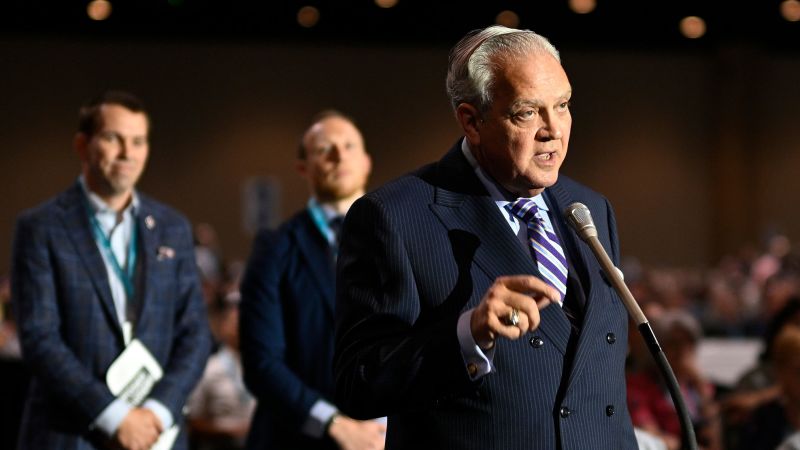
The two-day annual meeting, held in Orlando, Florida, drew over 11,000 delegates, or “messengers,” to a vast convention center, creating a vibrant atmosphere that blended worship with rigorous debate. The SBC’s gatherings are known for their town hall-like dynamics, where members engage in discussions that range from doctrinal matters to administrative decisions. This year’s meeting, however, was marked by a contentious debate over the location of the next annual meeting, which outlasted the discourse on women pastors. The logistical dispute, which focused on potential host cities, underscored the broader tensions within the denomination about how to define and enforce its core beliefs.
Albert Mohler, president of the Southern Baptist Theological Seminary in Louisville, Kentucky, played a central role in sponsoring the amendment. He emphasized that the vote was a critical moment for the denomination, framing it as a battle between “liberal” and “biblical” evangelicalism. “This is an opportunity for Southern Baptists to speak in truth, in unity, and in conviction,” Mohler said. “There’s a clear line that separates traditional beliefs from modern interpretations, and this issue brings that divide into sharp focus.” His remarks highlighted the amendment’s symbolic importance, positioning it as a reaffirmation of the SBC’s commitment to male leadership in the pulpit.
Theological Foundations and Constitutional Implications
The amendment seeks to codify the SBC’s existing faith statement, which already opposes the ordination of women as senior pastors. Southern Baptist leaders argue that biblical passages such as 1 Timothy 2:12 and Titus 1:6 establish men as the primary authority for pastoral roles. These verses, they claim, provide a clear mandate for male leadership in the church. However, advocates for women’s ministry countered that other scriptural references, like Galatians 3:28 and Ephesians 5:21, emphasize equality between genders and illustrate women’s active roles in proclaiming the gospel.
While the SBC cannot dictate specific practices to its autonomous churches, it retains the power to expel congregations that deviate from its doctrinal standards. The amendment’s language would require the removal of any church that “affirms, appoints, or endorses a woman serving in the office or function of a pastor/elder/overseer, specifically preaching to the assembled congregation.” This provision aims to create constitutional clarity on an issue that has long been a point of contention within the denomination. Mohler, who led the drafting of the ban in 2000, noted that the amendment would formalize a position that has already been broadly accepted by SBC members.
Historical Context and Continued Resistance
The push for this amendment is not new, but it has gained momentum in recent years. In the past three annual meetings, a majority of delegates supported similar constitutional changes to restrict women’s roles in pastoral leadership. However, only once did the measure secure the necessary two-thirds supermajority, leaving it in limbo for years. The current vote, Mohler argued, reflects a shift toward definitive action, driven by a desire to align the denomination more closely with its traditional values.
Despite the strong support for the amendment, there was limited opposition. Doug Mize, a pastor from South Carolina, was the sole voice against it, contending that the SBC’s existing mechanisms already suffice to address churches with women in senior pastoral positions. “What we have already works,” Mize said, referring to the denomination’s ability to expel congregations deemed incompatible with its faith and practice. He criticized the need for a constitutional amendment, suggesting that the current system of expulsion is sufficient to maintain unity.
The decision to formalize the ban has broader implications for the SBC’s relationship with churches that have already been expelled. For example, Saddleback Church in California, a prominent congregation with a female senior pastor, was removed from SBC membership in 2019 under the existing clause that penalizes churches whose “faith and practice” diverge from the denomination’s standards. The new amendment would expand this framework, making the exclusion of women pastors a constitutional right rather than a temporary disciplinary action.
Contrasting Denominational Practices
The SBC’s approach stands in contrast to many liberal Protestant denominations, which have long embraced the ordination of women and appointed them to leadership positions. In contrast, conservative evangelical groups exhibit a wide range of practices. While some, like certain Pentecostal and charismatic congregations, have embraced female pastors, others remain steadfast in their opposition. Notable examples include Paula White-Cain, who leads the White House Faith Office under President Donald Trump and is a prominent figure in the charismatic movement. However, groups such as the Catholic and Orthodox churches, which are among the largest Christian denominations globally, ordain only men to the priesthood, reinforcing the idea that male leadership is a longstanding tradition.
Within the SBC, the debate over women’s roles has persisted even as most members agree that the denomination’s faith statement rejects their appointment as senior pastors. The question now is whether the amendment will close the door on women serving in assistant or preaching roles. Mohler acknowledged this nuance, stating that the resolution aims to clarify the boundary between acceptable and unacceptable practices. “We need constitutional clarity on this issue,” he said, emphasizing that the amendment would ensure consistency across the denomination.
A Divided Response and Future Uncertainty
The vote has drawn mixed reactions. Baptist Women in Ministry, an organization supporting female clergy across various Baptist denominations, expressed disappointment. “We express our solidarity with the women in ministry who have been harmed by this vote, the hateful rhetoric and propaganda leading up to the vote, and the damas,” the group stated, referencing the controversy surrounding the measure. While the SBC’s leadership sees the amendment as a necessary step to preserve theological integrity, critics argue it risks alienating progressive members and reinforcing traditionalist views.
As the SBC moves closer to enshrining the ban in its constitution, the decision may influence the denomination’s identity and future direction. With a clear majority in favor, the amendment appears to have secured its place, though the final approval will depend on the delegates’ willingness to uphold the two-thirds threshold. This resolution marks another chapter in the ongoing struggle between traditional and modern interpretations of biblical authority within the Southern Baptist Convention.