Slavery Panels at Washington’s Philadelphia Residence Undergo Federal Reinstallation
Nighttime Removal Sparks Community Concern
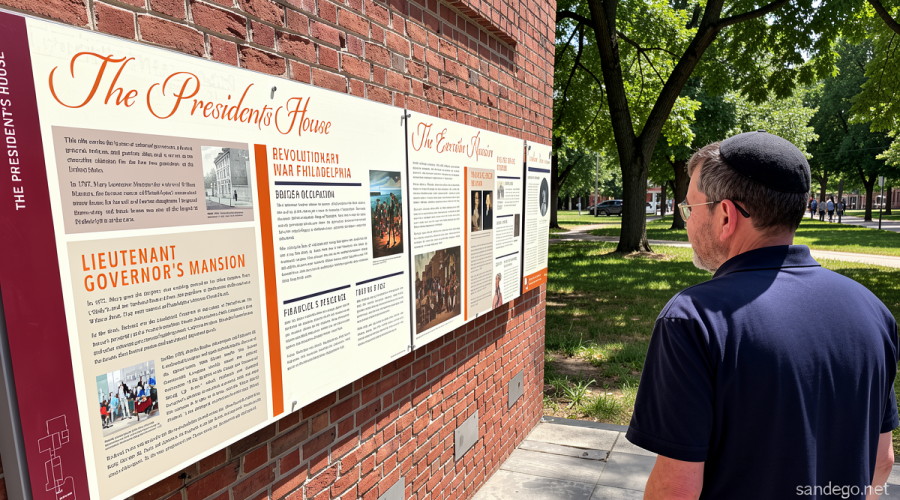
Sandego.net – The federal government has completed its commitment to revise and reinstall interpretive panels concerning slavery at the historic location of President George Washington’s Philadelphia residence. This development comes after critics raised alarms that the updated displays—substituting for those originally exhibited since 2010—might diminish the historical narrative of slavery. The freshly installed panels were positioned Wednesday morning within the very space where the Declaration of Independence received its adoption on July 4, 1776.
Philadelphia’s mayor, Cherelle L. Parker, expressed strong disapproval of the timing and manner of the removal. She stated that federal authorities took down the panels overnight while darkness provided cover. According to Parker, while a federal court decision permitted this action, the nocturnal execution demonstrated that officials recognized the operation as embarrassing and contrary to community confidence.
Overnight, under the cover of darkness, the federal government removed panels at the President’s House that told a thorough history of Philadelphia. It was allowed to do this by the decision of the federal court, but that it did so at night shows it understands this action is shameful, that it violates community trust.
Legal Battles and Panel Evolution
The original displays, first placed in 2010, narrated how nine enslaved individuals resided alongside George and Martha Washington during the 1790s, a period when Philadelphia briefly served as the nation’s capital. These panels underwent revision following an executive order issued by President Donald Trump in 2025. That directive instructed federally owned or controlled historic sites to avoid presenting information that might “disparage Americans past or living” and instead emphasize the “greatness of the achievements and progress of the American people.”
Legal proceedings have been extensive. A lower court mandated federal removal of the revised panels in February, even though they had already been installed earlier that year. Subsequently, a three-judge panel within the US 3rd Circuit of Appeals overturned that ruling on July 3, permitting the work to proceed.
Content Changes and Omissions
A government website featuring photographs of the new panels indicated that enslaved individuals who dwelled in the residence would still receive mention. Additional content encompasses the abolitionist movement, constitutional treatment of slavery, Pennsylvania’s emancipation timeline, perspectives of Washington and his successor John Adams on slavery, and coverage of the 20th century Civil Rights movement.
Nevertheless, certain elements from the earlier displays have disappeared. These omissions include a map illustrating slave trade routes and a comprehensive timeline documenting slavery’s progression. The new panels also sidestep pointed headlines like “The Dirty Business of Slavery” that characterized previous versions.
Continued Legal Challenges
Philadelphia initiated litigation against the federal government regarding the removal of previously included information. The city contended that federal authorities must engage in consultation before modifying the President’s House Site. Justice Department representatives maintained that the administration possesses sole authority to determine narratives presented at National Park Service properties.
Mayor Parker announced that the city plans to pursue a rehearing addressing “serious legal issues” identified within the appeals court’s ruling. Meanwhile, Michael Coard, an attorney and founder of the Philadelphia-based Avenging The Ancestors Coalition (ATAC), confirmed that his organization continues developing legal approaches to counter the Trump administration’s modifications.
Trump is attempting to rewrite history, Coard told reporters Wednesday near the site. What if there’s a president next time who doesn’t like the Liberty Bell because the Liberty Bell was used by abolitionists to support the end of slavery? What if there’s a president who doesn’t like the Statue of Liberty because too many immigrants come in? Do we remove the Statue of Liberty?
Government Defense of New Panels
The Interior Department provided The Associated Press with a statement Wednesday defending the updated displays. The department characterized the panels as containing substantial historical context while highlighting significant events occurring at the President’s House and other Independence National Historical Park locations.
The new panels are full of historical context and highlight the momentous events that took place in the President’s House and the other sites at Independence National Historical Park. They acknowledge the evils of slavery, including its injustices and hypocrisies, and, by telling the stories of the nine slaves that Washington kept in the President’s House, remind us of their essential humanity.
As legal proceedings continue and community members voice their perspectives, the controversy surrounding these interpretive displays illustrates broader tensions about how American history should be presented and who holds authority over that narrative.