Conor McGregor Suffers Early Injury in UFC 329 Return
Sandego.net – Conor McGregor suffers early injury in his highly anticipated comeback to the octagon. The Irishman’s return to competition at UFC 329 ended abruptly on Saturday evening when a leg injury forced him to withdraw from his bout against Max Holloway. The contest concluded in just 1:09 of the opening round, leaving fans to wonder what might have been had McGregor remained healthy throughout the five-round welterweight championship clash.
A Spectacular Start Turns Sour
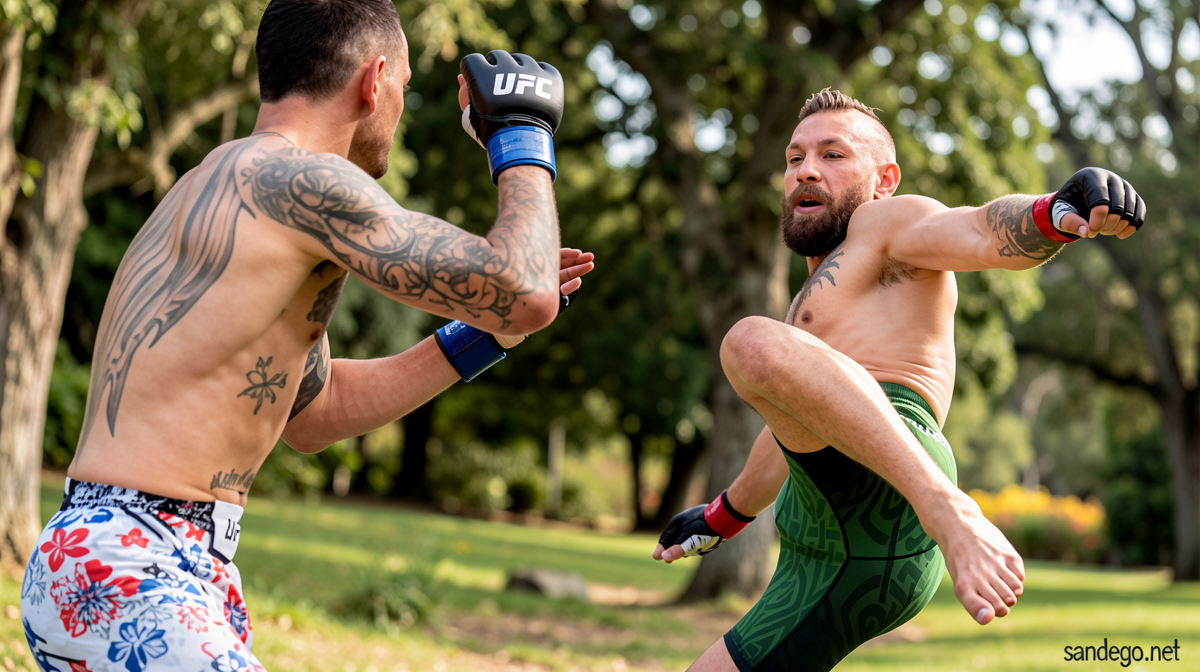
Fighting for the first time in over half a decade, McGregor launched into action with his characteristic flair. As the bell sounded to begin the bout, the former two-division champion executed a flying left roundhouse kick that sent him soaring across the ring. Unfortunately, the spectacular maneuver ended in disaster as McGregor landed awkwardly on his right knee, immediately signaling trouble for the 22-7-0 fighter.
Despite the obvious discomfort, McGregor attempted to continue, trying to kick and strike Holloway two additional times before it became painfully clear that he could not complete the scheduled distance. The 28-9-0 Holloway, who entered as a -300 favorite at Bet MGM Sportsbook, capitalized on his opponent’s misfortune to secure the victory. For those who placed wagers, the odds told an interesting story: a bettor would need to risk $300 to win $100 on Holloway, while a $100 wager on McGregor would have returned $240 in profit.
Perfect Timing for a Homecoming
The sold-out arena provided a fitting backdrop for McGregor’s return. The Irishman made his way to the ring accompanied by the iconic sounds of Notorious Biggie Smalls’ “Hypnotize,” greeted by thunderous cheers from the enthusiastic crowd. The timing of the event proved particularly meaningful, as McGregor’s last appearance in the octagon occurred exactly five years and one day before this Saturday night’s card.
Adding to the celebratory mood, the event took place just hours after McGregor’s home country of England secured a quarterfinal victory over Norway in the World Cup. This sporting double-header created an electric atmosphere that permeated the entire venue.
Supporting Card Delivers Excitement
Beyond the McGregor-Holloway main event, several other bouts delivered excitement for the audience. Liverpool’s Paddy Pimblett, sporting a 24-4-0 record, delivered a stunning performance against Benoit Saint Denis. The +120 underdog blocked an incoming roundkick, immediately shot in, and applied a front headlock that sent Saint Denis (17-4-0) to sleep in just 52 seconds for a first-round TKO victory.
In the bantamweight division, Mario Bautista (18-3-0) demonstrated his technical prowess against Cory Sandhagen (18-7-0). Bautista capitalized on an effective first-round leg kick and maintained consistent pressure throughout each subsequent round. A flurry of punches in the third round ultimately secured the unanimous decision in his favor.
The flyweight division saw Brandon Royval (18-9-0) claim victory over Lone’er Kavanagh (10-2-0) through submission. In a scheduled three-round contest, Royval applied a rear-naked choke at the 3:40 mark of the final round to secure his win.
Main Card Opener Stuns Crowd
Perhaps the most surprising result of the evening came in the opening bout of the main card. King Green (36-17-0), who appeared to be taking a severe beating for nearly the entire first round against Terrance McKinney (18-9-0), managed to find his footing. With roughly 20 seconds remaining in the round, Green landed a devastating right hand to McKinney’s jaw, then finished the job for a TKO at the 4:59 mark. The comeback from what seemed like certain defeat left spectators in disbelief.
This story continues to develop as more details emerge from UFC 329. Updates will be provided as additional information becomes available regarding McGregor’s injury and the full results from the event.