
The four astronauts NASA picked for the first crewed moon mission in 50 years
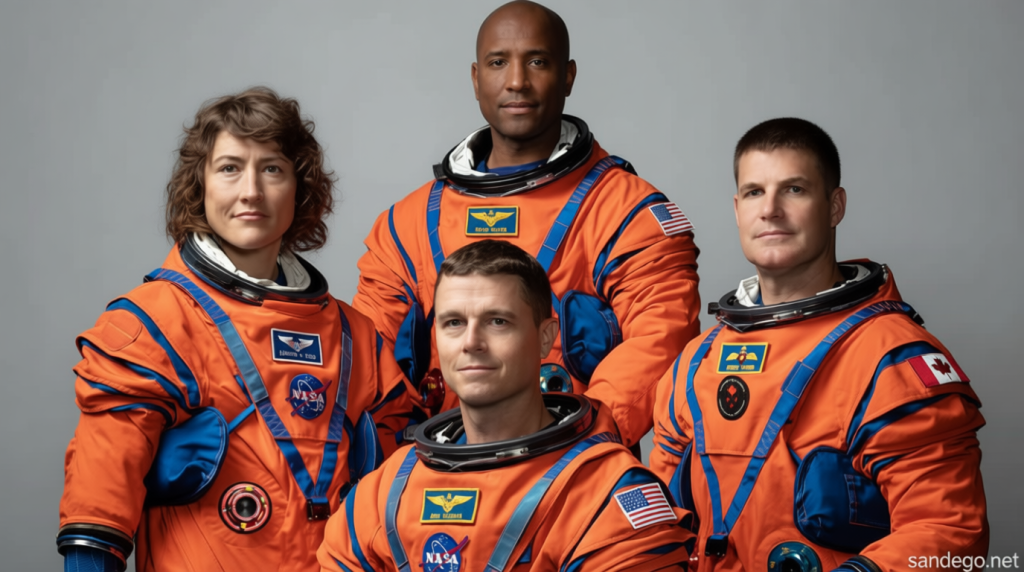
The four astronauts NASA picked for the first crewed moon mission in 50 years
NASA has unveiled the astronauts set to lead the first manned lunar expedition in half a century. The mission, Artemis II, is scheduled to launch in November 2024, marking a pivotal moment in space exploration. The crew includes Reid Wiseman, Victor Glover, and Christina Koch from NASA, alongside Jeremy Hansen of the Canadian Space Agency.
Reid Wiseman: Commander with a seasoned background
Wiseman, 47, is a decorated naval aviator and test pilot. He was first chosen for the NASA astronaut program in 2009 and completed a 165-day mission to the International Space Station aboard a Russian Soyuz rocket in 2014. Prior to his current role, he served as head of the astronaut office until November 2022.
As commander of Artemis II, Wiseman will oversee the crew’s journey aboard the Orion spacecraft. The mission will launch using a NASA-developed Space Launch System rocket from Kennedy Space Center in Florida, with a planned duration of approximately 10 days.
Jeremy Hansen: Canada’s first deep-space explorer
Hansen, 47, is a fighter pilot selected for astronaut training by the Canadian Space Agency in 2009. Hailing from London, Ontario, he is among only four active Canadian astronauts. He recently assumed responsibility for training a new NASA astronaut class, a first for his country.
The mission will be his debut into deep space, a milestone that follows his extensive experience in aviation and space operations. His role as a crew member will involve navigating the challenges of a lunar flyby and eventual return to Earth via a Pacific Ocean splashdown.
Victor Glover: From Senate to space
Glover, 46, transitioned from a career in politics to become a NASA astronaut in 2013. Before joining the space program, he worked as a legislative fellow in the U.S. Senate. His military service spanned across squadrons in the U.S. and Japan during the 2000s, including test pilot training with the US Air Force.
Glover’s first spaceflight in 2021 involved piloting SpaceX’s Crew Dragon spacecraft for nearly six months on the International Space Station. He emphasized the historic weight of the announcement during the NASA Johnson Space Center event, stating,
“It’s so much more than the four names that have been announced. We need to celebrate this moment in human history. … It is the next step in the journey that will get humanity to Mars.”
Christina Koch: Record-breaking engineer and explorer
Koch, 44, holds the distinction of being the longest-serving female astronaut in space, with a total of 328 days logged during her missions. She also contributed to the development of scientific instruments for various NASA projects. A native of Grand Rapids, Michigan, she spent a year at the South Pole, an experience that may have prepared her for the rigors of a lunar mission.
Koch’s participation in the first all-female spacewalk in 2019 highlights her role in breaking barriers. The Artemis II crew will embark on a voyage that could extend farther than any human journey beyond the Moon, though the exact distance will depend on launch conditions and the Moon’s position at the time.
Artemis I, the uncrewed precursor mission, successfully tested the Orion capsule with a 1.4 million-mile lunar orbit in December. NASA continues to analyze the data collected. If everything proceeds as planned, Artemis II will be the first crewed mission to revisit the Moon since the Apollo program concluded in 1972.
Artemis III, set for later this decade, aims to land the first woman and person of color on the lunar surface. However, key technologies such as spacesuits and a lunar lander are still under development, ensuring the mission remains a critical step toward long-term exploration goals.
