Keiko Fujimori’s Fourth Bid for Peru’s Presidency
Sandego.net – At just 19, Keiko Fujimori became Peru’s first lady, a role that would set the stage for her future political ambitions. Her appearance at the 1994 Summit of the Americas, held in Miami under U.S. President Bill Clinton, marked her first international exposure. Dressed in black, the young woman seemed reserved and uncertain in front of cameras, standing beside her father, Alberto Fujimori, who was then in his second year as president. This moment, though brief, symbolized the beginning of her political journey, which would later be shaped by the events surrounding her mother’s decision to leave the family.
From First Lady to Presidential Candidate
Susana Higuchi, Keiko’s mother, parted ways with Alberto Fujimori after publicly accusing him of corruption during the handling of foreign funds. The separation opened the door for Keiko to step into the spotlight, transitioning from a ceremonial role to a more active presence in politics. Her early years in public life, though marked by humility, would eventually evolve into a career defined by ambition and controversy.
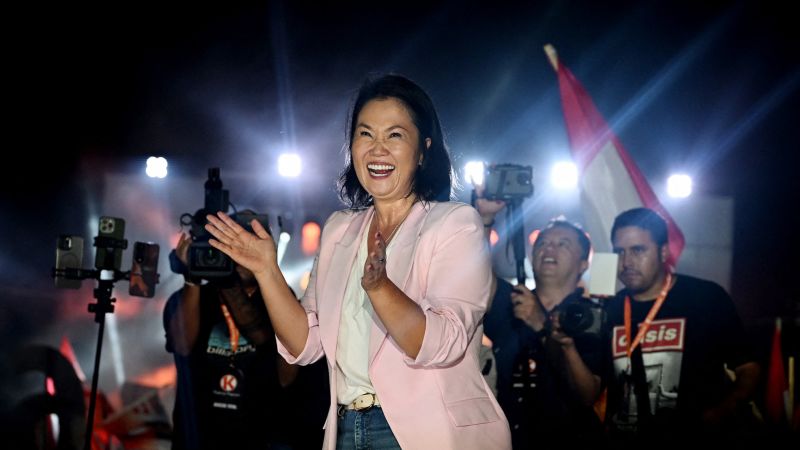
Now, at 51, Keiko Fujimori is poised for her fourth attempt to secure the presidency in a runoff election. Despite losing three previous bids in 2011, 2016, and 2021, she remains a formidable contender. Her opponent in this election is Roberto Sánchez, a leftist candidate from the Juntos por el Perú (Together for Peru) party. While some polls suggest a narrow edge for Fujimori, her campaign has emphasized a fresh direction for the nation. “We need order—order to live, order to invest, order to work,” she asserted during a televised debate, framing her bid as a solution to Peru’s ongoing instability.
Political Legacy and Institutional Crisis
Fujimori’s candidacy is closely tied to her father’s complex legacy, which has divided the country for decades. Alberto Fujimori, who served as president from 1990 to 2000, oversaw economic recovery and defeated the Shining Path and MRTA terrorist groups in an internal conflict that claimed over 60,000 lives. However, his tenure was also marred by allegations of human rights abuses and corruption, leading to legal proceedings years later. These scandals cast a long shadow over Keiko’s political career, with her often viewed as the heir to an authoritarian regime.
The country has faced an unprecedented cycle of leadership, with eight presidents in the last ten years. This political turmoil has been compounded by corruption scandals and rising crime, creating a climate where voters seek stability. Fujimori positions herself as a unifying figure, promising to restore order and address these crises. “This election is not about me, but about the kind of government we want for the next five years,” she reiterated, emphasizing her focus on national recovery over personal gain.
A Political Comeback and Legal Challenges
Keiko Fujimori’s political path has been shaped by both triumphs and setbacks. She entered the congressional scene in 2000, founded the Fuerza Popular (Popular Force) party, and later faced a 13-month prison term under investigation for corruption. The charges alleged that she received money from the Odebrecht construction company to finance her campaigns, a claim she has consistently denied. In January 2025, a court declared the case against her null and void, citing insufficient evidence. Fujimori called this ruling a vindication, arguing it signified a decade of political persecution.
The 2021 runoff election against former President Pedro Castillo, a leftist, was a pivotal moment. Allegations of voting irregularities plagued the process, and Fujimori was forced to acknowledge past mistakes. “I know I’ve made errors in my political life,” she admitted in a speech following the debate. “I learned from them, but I also emerged stronger.” This self-reflection has become a cornerstone of her campaign, as she aims to reconnect with voters disillusioned by the country’s repeated crises.
In contrast to her earlier, more combative image, Fujimori has adopted a measured tone in recent months. “We were confrontational, but we’ve corrected that,” she stated in an interview, signaling a strategic shift. Political analysts like Julio Carrión, a professor at the University of Delaware, note this evolution. “Her campaign is now more calculated, focusing on unity rather than ideological clashes,” Carrión observed. He added that Fujimori’s 2021 image, which framed her as a defender of democracy against communism, was a critical misstep. “The election became a referendum on her father’s legacy, not her own vision,” the expert explained.
Rebuilding Trust and Facing the Future
Fujimori’s campaign has also navigated the fallout from the 2021 runoff, where she was accused of supporting claims of voting fraud by Rafael López Aliaga, a candidate from the Popular Renewal party. While some initially expected her to align with these allegations, she chose a more neutral stance, highlighting her ability to adapt to changing political dynamics. This approach has been part of her effort to distance herself from her father’s controversies while leveraging his popularity.
The Fujimori family’s influence remains a double-edged sword. While her father’s policies undeniably reshaped Peru’s economy and security landscape, his later convictions and prison sentences have fueled anti-Fujimori sentiment. Keiko has sought to redefine her identity, portraying herself as a pragmatic leader rather than a continuation of her father’s regime. “I am not the same as my father,” she said during a rally, “but I carry his values forward for the people’s benefit.”
Fujimori’s path has been marked by resilience. From her early days as a first lady to her current bid for the presidency, she has consistently sought to redefine her narrative. The 2026 election represents her latest opportunity to address the nation’s challenges, from economic inequality to systemic corruption. Her campaign’s focus on security and order aligns with a broader public demand for stability, particularly as Peru grapples with its eighth president in ten years.
As the runoff approaches, Fujimori’s message is clear: she is the best hope for restoring Peru’s fractured institutions. “We must build a future where citizens can trust their leaders and feel safe in their communities,” she declared. Her ability to recalibrate her image and appeal to a diverse electorate will be crucial in determining the outcome. Whether she succeeds or not, her journey underscores the enduring impact of political dynasties in shaping a nation’s destiny.
Alberto Fujimori’s death in 2024 has not diminished the weight of his legacy. His policies, once celebrated, now serve as both a foundation and a point of contention for Keiko’s campaign. As she steps into the role of presidential candidate, the Fujimori name continues to be a powerful symbol, reflecting the nation’s complex relationship with its past and future.
Conclusion
Keiko Fujimori’s fourth presidential run is a testament to her persistence and adaptability. From the quiet moments of her first lady days to the assertive leadership she now projects, she has navigated a political landscape shaped by her family’s history. Her campaign, while still rooted in her father’s era, now emphasizes a new direction for Peru. The runoff election will not only test her political acumen but also the nation’s readiness to embrace change. As the polls close, the question remains: will her vision of order and stability resonate with voters, or will her past be the deciding factor?