July 4, 1776: A Day of Unusual Priorities for Thomas Jefferson
July 4 1776 – On the morning of July 4, 1776, the weather in Philadelphia was marked by a gradual rise in temperature. The air was cool at dawn, registering 68 degrees Fahrenheit, but by 9 a.m., it had warmed to 72.25 degrees. By midday, the heat climbed to 76 degrees, creating a pleasant but notable climate. As the sun set, the temperature eased slightly to 73.5 degrees. These precise measurements are preserved in the meticulous records of Thomas Jefferson, who documented the day’s weather conditions four times. While history remembers July 4 as the day the United States declared independence from Britain, Jefferson’s personal accounts reveal a different narrative—one centered on the mundane yet revealing act of shopping.
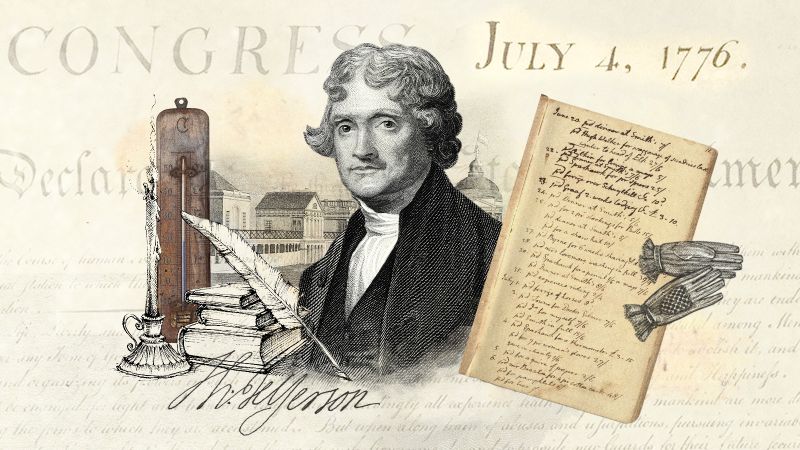
Jefferson’s attention to the weather on that pivotal day was not incidental. The Continental Congress was in the final stages of adopting the Declaration of Independence, a document that would sever ties with King George III and establish the foundation for a new nation. Yet, Jefferson’s own records show he was also preoccupied with household purchases. According to his detailed memorandum books, he bought a thermometer from John Sparhawk, a local apothecary and bookseller on Second Street, for three pounds and 15 shillings. This purchase was part of a broader spending spree, during which he also acquired seven pairs of women’s gloves for 17 shillings. Additionally, Jefferson noted a charitable donation of one shilling and six pence. These details, though seemingly trivial, offer a glimpse into the daily rhythms of a man whose legacy is defined by monumental political decisions.
A Mere Shopping Day?
How could a day so central to American history be associated with such ordinary activities? Scholars have long debated whether Jefferson’s focus on errands reflected a lack of urgency or a unique balance of priorities. Andrew Davenport, vice president of research at Monticello, Jefferson’s estate, suggests that the day was far from unremarkable. “It’s a mundane day, except it’s a revolutionary one,” he remarked. “The fact that Jefferson could attend to both the birth of a nation and the upkeep of his household illustrates how everyday tasks are essential to civic life. Without these routines, the grandeur of revolution might not have been possible.”
Davenport’s perspective highlights the duality of July 4, 1776. While the world would later celebrate it as a symbol of freedom and independence, the day itself was part of a longer process. The Continental Congress had spent months debating and refining the Declaration, with its formal adoption occurring on July 2. That date, according to historical accounts, was considered the more significant moment. John Adams, in a letter to his wife Abigail on July 3, anticipated the day’s importance: “The Second Day of July 1776, will be the most memorable Epocha, in the History of America. It ought to be commemorated, as the Day of Deliverance by solemn Acts of Devotion to God Almighty.” Adams envisioned a grand celebration, with parades, bonfires, and public festivities spanning the continent.
Yet, by the time July 4 arrived, much of the work had already been completed. The committee tasked with drafting the Declaration—led by Jefferson—had submitted its work to Congress by June 28. This left Jefferson and others with the responsibility of finalizing details and preparing for the public unveiling. As James P. McClure, general editor of the Papers of Thomas Jefferson project and a historian at Princeton University, noted, “The actual adoption of the Declaration on July 4 was a procedural step, not the defining moment of the revolution.” The day’s significance, McClure argued, lay in its role as the culmination of months of effort, not in any dramatic events.
Jefferson’s personal expenditures on July 4 further underscore this contrast. His purchase of the thermometer, though small in the grand scheme of history, was a practical investment. The instrument was likely used to monitor the conditions under which the Declaration would be printed and distributed. This detail, however, also raises questions about Jefferson’s time management. Could he have been so focused on the weather that he neglected the political urgency of the moment? Or was his ability to handle both tasks a testament to his multifaceted role as a leader?
The Fabric of Civic Life
Jefferson’s actions on July 4, 1776, have sparked discussions about the nature of leadership during revolutionary times. Cara Rogers Stevens, a Jeffersonian scholar at Ashland University in Ohio, proposed that the day’s events might reflect Jefferson’s lighter workload compared to his contemporaries. “It’s possible that Jefferson wasn’t involved in as many committees as some of his peers, like John Adams,” Stevens suggested. “That would explain why he had the bandwidth to engage in household errands while others were preoccupied with the nation’s destiny.”
Stevens’ theory challenges the notion that all Founding Fathers were equally consumed by the revolution’s demands. While Jefferson was the primary author of the Declaration, other members of Congress were deeply involved in shaping the document’s language and ensuring its passage. This分工 (division of labor) allowed Jefferson to focus on aspects like the weather, which might have influenced the timing of the Declaration’s publication. The historical record suggests that the final approval of the document occurred in the morning, with the Congress likely completing its work before the day’s temperatures cooled.
Jefferson’s ability to juggle monumental responsibilities with everyday tasks is a reminder of the complexities of revolutionary leadership. As Davenport explained, “Daily business—like shopping or recording temperatures—was the backbone of civic life. Even during the most intense periods of history, people needed to manage their personal and professional affairs.” This idea aligns with the broader theme of how ordinary activities can underpin extraordinary moments. The Declaration of Independence, while a landmark event, was the result of countless smaller decisions and efforts, many of which remain overlooked.
Historians now view July 4, 1776, not as a day of grand proclamation but as a continuation of the work that had already begun. The Continental Congress had spent the previous months in rigorous debate, with its members weighing the costs and consequences of declaring independence. By the time the document was formally adopted on July 4, the rebellion’s foundation was already laid. This shift in perspective allows us to appreciate the significance of Jefferson’s shopping trip as a symbol of the human element in history—a reminder that even the most iconic figures had to balance the extraordinary with the everyday.
In the end, the day remains a testament to the intersection of history and routine. Jefferson’s records, once dismissed as trivial, now provide a unique window into the life of a man who shaped a nation. The temperatures he logged, the gloves he bought, and the charitable gift he made all contribute to a richer understanding of the era. As the world celebrates July 4 as the birth of a new country, it’s worth remembering that for Jefferson, it was just another day—marked by both revolution and the simple act of shopping.