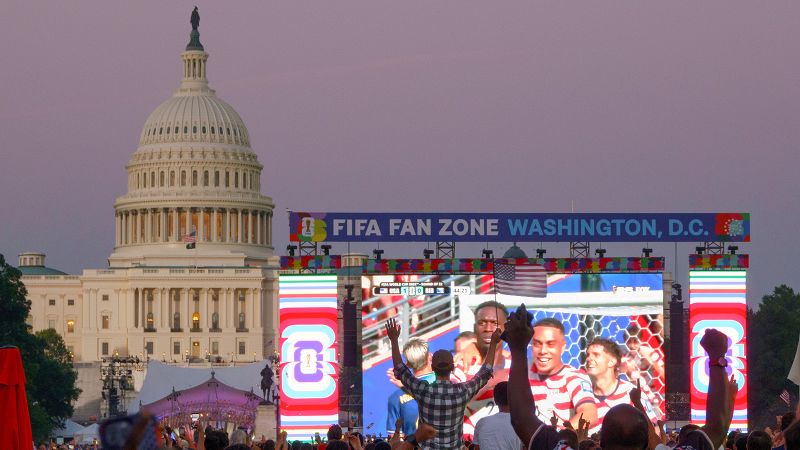
America held a big birthday party — and a soccer extravaganza broke out
America held a big birthday party – As the United States marks its 250th anniversary, the World Cup has become a powerful symbol of national unity, offering a rare moment of collective joy that transcends the nation’s often contentious political landscape. The tournament, which began on July 4, has transformed cities across the country into hubs of celebration, drawing fans from every corner of the globe and reminding them of America’s enduring spirit of inclusivity. In a year defined by ideological divides and economic uncertainty, the game has provided a respite, showcasing how the nation’s diversity can foster shared experiences and camaraderie.
The Global Mirror of American Identity
The World Cup’s arrival has not only brought excitement to soccer enthusiasts but also highlighted the cultural mosaic that defines the United States. From the bustling stadiums to the crowded bars and streets, the event has mirrored the country’s ethnic complexity. Immigrants, who have long contributed to America’s social and economic fabric, are now at the center of this celebration. Their presence underscores the nation’s role as a melting pot, where traditions from Mexico, Brazil, Colombia, and Europe intertwine in a way that reflects its dynamic history.
One of the most striking aspects of the tournament is the blend of global talent on Team USA’s roster. The squad, managed by an Argentinian coach, features homegrown players and recent recruits, symbolizing the intersection of heritage and opportunity. For instance, Antonee Robinson, a left-back whose father was a standout in college soccer, grew up in the north of England, where he adopted the accent and rhythms of his adopted home. Similarly, midfielder Malik Tillman, the child of an American serviceman and a German mother, developed his skills in Germany’s competitive youth soccer system. These stories illustrate how the American dream is woven into the lives of individuals who carry the legacy of their ancestors while building new futures in the United States.
The Politics of the Pitch
Despite the celebratory atmosphere, the World Cup has also drawn scrutiny from those who view sports as a battleground for political ideology. FIFA’s leadership, particularly Gianni Infantino, has faced criticism for aligning with authoritarian regimes and awarding a peace prize to former President Donald Trump. Yet, Infantino’s remarks in Los Angeles last year still resonate: “We can see, well, actually this other person from this other part of the world, he’s not so bad or she’s not so bad as described, right?” His words reflect the hope that soccer can bridge divides, offering a platform for mutual understanding in a polarized era.
On the field, the U.S. team’s success has been a testament to the nation’s ability to unite through sports. The squad’s blend of players from different backgrounds—like Brooklyn-born Folarin Balogun, whose Nigerian parents raised him in England—has created a narrative that celebrates both individual identity and collective achievement. Balogun’s recent goal for Team USA, scored just days after the Supreme Court upheld the constitutional principle of birthright citizenship, has become a poignant symbol of the country’s resilience. In a time when immigration policies have been a flashpoint for debate, his presence on the field highlights the enduring value of diversity.
Meanwhile, the tournament has also sparked discussions about the role of sports in American culture. As the nation grapples with debates over social issues—such as players kneeling during the national anthem or stars using their platforms to critique politics—the World Cup has offered a temporary reprieve. The excitement of the game has brought people together, proving that even in an age of digital distraction, the simple act of gathering for a common purpose can reignite a sense of community. For many, this has been a refreshing contrast to the culture wars that dominate headlines.
A Cultural Renaissance
The World Cup’s impact extends beyond the stadiums, revitalizing cities that have seen economic shifts and remote work redefine urban life. In places where the pandemic led to a decline in social activity, the tournament has reignited the pulse of neighborhoods. Fans in jerseys of multiple national teams have flooded the streets, creating a vibrant tapestry of cultural expression. This phenomenon has reminded observers that America’s identity is not confined to its political debates but is also shaped by the countless stories of immigrants and their descendants.
Team USA’s rise has been a catalyst for this cultural renaissance, proving that soccer can be a unifying force in a country often divided by partisan lines. The team’s achievements, much like those of the Women’s National Team, have become a rare common cause that cuts across political affiliations. Unlike the ice hockey team, which saw its Olympic triumph overshadowed by political discourse, the U.S. squad has managed to maintain its momentum, offering a model of how sports can transcend partisanship.
The tournament’s success has also sparked conversations about the future of American sports. With its blend of European and South American stars, as well as emerging talent from Africa and Asia, the World Cup has presented a vision of the United States as a global player. This diversity mirrors the nation’s own history, where waves of immigration have continuously enriched its cultural landscape. The event has become a reminder that America’s strength lies in its ability to absorb and celebrate different traditions, creating a unique identity that is both inclusive and resilient.
As the World Cup progresses, its legacy will likely extend beyond the field. The shared experience of cheering for a team that represents the nation’s multicultural roots has already begun to reshape perceptions. For international visitors, the tournament has provided a glimpse into a country that is not only welcoming but also complex—a place where the past and present coexist, and where the joy of sport can momentarily set aside the divisions that define political life. The 250th anniversary of the United States has become a backdrop for this celebration, offering a chance to reflect on the nation’s founding ideals and their relevance today.
Gianni Infantino’s vision of the World Cup as a global event that complements national celebrations has come to life in unexpected ways. By aligning the tournament with the U.S. bicentennial, he emphasized the idea that football is not just a sport but a cultural phenomenon capable of fostering unity. This year’s World Cup, however, has also revealed the challenges of maintaining that ideal. The initial concerns about over-commercialization, exorbitant ticket prices, and political favoritism have given way to a broader appreciation of the game’s ability to bring people together. As the tournament unfolds, it continues to serve as a powerful reminder of America’s potential to be more than its political caricatures suggest.
The World Cup’s arrival has thus become more than a sporting event; it is a mirror reflecting the nation’s spirit. In a time when immigrants are often portrayed as outsiders, the enthusiasm of fans from diverse backgrounds has shown that they are integral to America’s story. The tournament’s success has also reinforced the idea that the United States can be a place where differences are not just tolerated but celebrated. As the celebrations continue, the World Cup offers a hopeful vision of what the nation can achieve when it chooses to look beyond its divisions and embrace its shared humanity.
“When we learned that in 2026, there is the 250th anniversary of the United States, we thought, well, you know, you have a celebration — we organize a party,” said Gianni Infantino, FIFA’s president, during a speech in Los Angeles last year. His words, though made in 2023, have taken on new meaning as the World Cup has become a global stage for America’s cultural and historical narrative.
Ultimately, the intersection of the World Cup and the U.S. bicentennial has created a unique moment in history. It is a time when the nation’s love for soccer—once a niche interest—has become a unifying force. As the tournament progresses, it continues to remind the world that America’s identity is as rich and varied as the players on its field, and that its capacity for celebration is a testament to its enduring spirit.