Minnesota’s 48-Star US Flag Mystery Unfolds
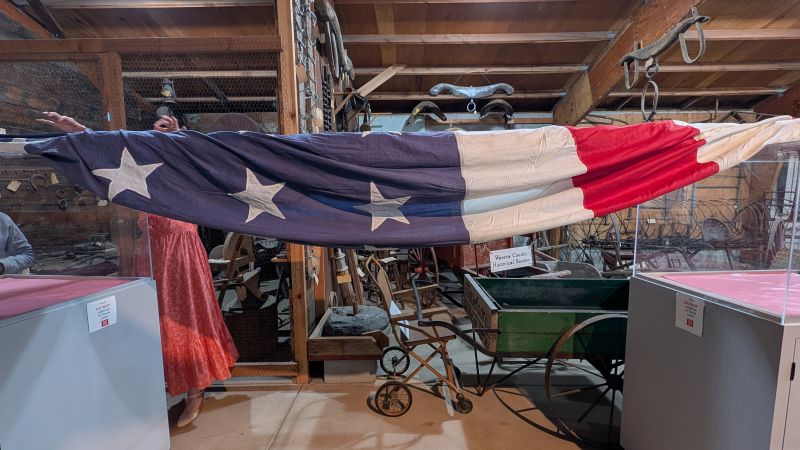
A 48 star US flag the size – A 48-star US flag, as large as a single-bedroom apartment, has sparked a red, white, and blue mystery in Minnesota. During the routine preparation for the annual county fair in Waseca County, a peculiar discovery emerged from the dust and cobwebs of a historic cabin on display at the fairgrounds. Volunteers uncovered a massive bundle wrapped in oil cloth, hidden within the eaves of the structure. “What’s that?” one county commissioner asked, igniting curiosity among the group. The item, once extracted and unrolled, revealed a surprising sight: a colossal American flag, its dimensions so vast it required multiple people to handle. Measuring roughly 19 by 36 feet, the flag spans over 680 square feet—a size comparable to a standard one-bedroom apartment in New York City. Its presence has left the local community in awe, prompting questions about its origin, creation, and historical significance.
A 48-Star US Flag: A Historical Relic
The 48-star US flag’s design is a relic from a bygone era. This configuration was in use until 1959, just before Alaska and Hawaii joined the Union. Historical society members have confirmed that the stars were added in 1912, when New Mexico and Arizona became states, marking a pivotal moment in the nation’s expansion. “The United States emerged from the Great Depression and World War II as one of the leading nations of the world,” noted the National Park Service, providing context for the flag’s historical backdrop. However, the flag’s age remains uncertain, with its maker still shrouded in mystery despite clues hidden within its fabric.
The stars, each larger than an outstretched hand, are arranged in six horizontal rows, their placement meticulously crafted. Yet, the stitching reveals a story of amateur craftsmanship. “They failed to catch all the edges on many of the stars,” Elizabeth Anselmo, a curator with the Waseca County Historical Society, explained to CNN. “It’s clear that the creator or creators were not professionals, but they had a strong sense of purpose.” This inconsistency in the star edges, paired with the uniformity of the machine-sewn stripes, suggests a blend of manual and mechanical techniques. “It’s very uneven, and you can tell multiple people had their hands going to make it come to life,” Anselmo added, highlighting the collaborative effort behind the flag’s creation.
Unfolding a Historical Enigma
For decades, the 48-star US flag had been stored rolled up in a county fair building, its full potential obscured by years of neglect. Until recently, only small sections were displayed, a precaution to avoid violating the US Flag Code, which prohibits the flag from touching the ground. “It’s a symbol that needs to be respected,” Amy Danielson, a former co-director of the Waseca County History Center, remarked. “But the way it’s been kept hidden for so long only deepens the mystery.”
Now, the historical society has embarked on a mission to decode the flag’s origins. The combination of hand-stitched stars and machine-sewn stripes offers a glimpse into a time when traditional craftsmanship and industrial production coexisted. “This flag represents a transitional period in American history,” Danielson said. “It’s a tangible link to the past, but the details are elusive.” The uneven stitching and the lack of a comprehensive record have left researchers with more questions than answers. “It probably came in more than 50 years ago, and nobody that currently works here, or recently worked here, knows,” Danielson told CNN. The absence of a catalog entry further complicates the investigation, turning the artifact into a true enigma.
The 48-star US flag’s size alone suggests a ceremonial purpose, likely meant to be displayed in a prominent setting. “Its enormity indicates it was designed for visibility,” Danielson noted. “But where was it meant to be seen, and by whom?” The historical society’s efforts to unveil the flag have intensified, leading to a collaborative effort involving local volunteers and even the fire department. A plan was set to hoist the massive flag, but the existing wooden brace along its edge required significant reinforcement to support the weight. “We needed a way to lift it without damaging the structure,” said a member of the team. “The fire department’s help was crucial in making this possible.”
Communities Rally to Preserve History
On Monday morning, more than 50 volunteers gathered at the fairgrounds hall, ready to take part in the historic unrolling. The community’s collective effort underscored the flag’s importance as a symbol of shared heritage. “This isn’t just a piece of fabric—it’s a representation of our history and identity,” said one volunteer. The event marked the first time the 48-star US flag had been fully unfurled in decades, allowing for a detailed examination of its intricate design and aging material. “Every thread tells a story,” remarked a participant, as they carefully assessed the flag’s condition. “We’re uncovering something that’s been forgotten for generations.”
As the flag is examined, historians are piecing together its narrative. While the exact date of its creation remains unclear, its presence at the fairgrounds suggests it may have been part of a local tradition or used for a special occasion. “The flag could have been made for a parade, a school event, or even a personal milestone,” said Danielson. “But without more information, it’s hard to say.” The 48-star US flag continues to captivate locals, serving as a reminder of the nation’s evolving history and the enduring significance of its symbols. “It’s more than just a flag—it’s a piece of our collective story,” added Anselmo, as the community prepares to celebrate its rediscovery.