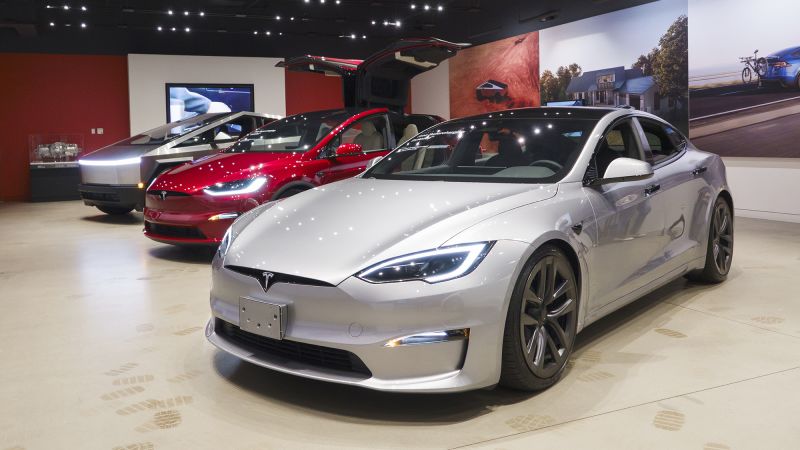
Tesla’s Q2 Sales Surge Signals Recovery in Europe Amid Rising Demand
Tesla sales soar 25 in sign – In a notable shift, Tesla reported a significant 25% rise in global sales during the second quarter of 2026, marking a potential turning point for the electric vehicle (EV) giant. The company delivered over 480,000 vehicles in the three months ending June 30, surpassing the 384,000 units shipped during the same period in 2025. While Tesla does not publicly separate regional sales data, the European market appears to have played a pivotal role in this rebound. According to the European Automobile Manufacturers’ Association (ACEA), Tesla’s sales in the region grew by 77% across the first five months of the year, suggesting a strong foundation for broader recovery.
Europe’s Role in Tesla’s Revival
The uptick in Tesla’s performance in Europe has been attributed to a combination of factors. Higher fuel prices in the region have made electric vehicles more attractive to consumers, while government incentives for EV adoption have further fueled demand. Additionally, a gradual softening of consumer discontent toward Elon Musk’s political influence has contributed to the positive trend. Musk’s support for far-right candidates in Germany and Britain, along with his involvement in Donald Trump’s administration, previously sparked criticism in Europe. However, the backlash seems to have eased, allowing Tesla to regain momentum.
Analysts note that this recovery aligns with broader industry trends. “Europe is bouncing back after a year of challenges driven by anti-Musk sentiment,” said Dan Ives, global head of technology research at Wedbush Securities, in an emailed statement to CNN. Ives highlighted that Tesla’s recent success could be a sign of resilience in the face of political headwinds. Meanwhile, Seth Goldstein, a senior equity analyst at Morningstar, attributed the sales increase to Tesla’s growing market share in Europe. He emphasized that affordability, combined with the expansion of fast-charging infrastructure, has made EVs more accessible to a wider audience.
Global Context and Strategic Adjustments
Despite the European recovery, Tesla’s global sales remain subject to external pressures. The company’s European deliveries dropped by 38% in 2025, a period marked by Musk’s political maneuvers and the absence of US EV tax credits. These credits, which had previously spurred demand in America, were removed, leading to a decline in potential buyers. However, Tesla’s Q2 results indicate that the company is adapting to these challenges. The increase in deliveries suggests that international markets, particularly Europe, are now acting as a key driver for growth.
Deutsche Bank analysts projected Tesla’s Q2 deliveries at 416,000, underscoring their confidence in the company’s ability to leverage global demand. This projection highlights the importance of Europe’s market performance, which has become critical to Tesla’s overall strategy. The EV maker’s focus on Europe may also reflect its efforts to offset declining sales in the US and to strengthen its position in regions where it has historically struggled.
Competition from Chinese EV Giants
While Tesla’s European revival is promising, it faces mounting competition from Chinese automakers. BYD, the world’s largest EV producer, overtook Tesla in 2025, claiming the top spot in global sales. BYD’s European growth has been even more dramatic, with a 159% increase in sales from January to May 2026. This surge has positioned BYD as a formidable rival, now holding a 12% lead over Tesla in the region after trailing behind its depressed sales figures last year.
Tesla’s renewed focus on Europe comes as it navigates a competitive landscape dominated by Chinese manufacturers. The rise of BYD and other Chinese EV brands has forced Tesla to recalibrate its strategies, emphasizing market share gains and infrastructure development. Goldstein noted that the European market is experiencing long-term growth, driven by the decreasing cost of EVs compared to traditional fossil fuel vehicles and the expansion of charging networks along highways and in urban areas. These developments are creating a more favorable environment for Tesla to regain its footing.
Looking Beyond the Car Industry
As Tesla strengthens its position in Europe, the company continues to pursue ambitions beyond the automotive sector. Its investment in autonomous driving and artificial intelligence remains central to its long-term vision. Last summer, Tesla launched robotaxis in select markets, a service utilizing vehicles equipped with full self-driving (FSD) technology. This initiative, part of Musk’s broader plan to transition Tesla into a tech-driven enterprise, has been slower than anticipated, with limited rollout progress compared to initial projections.
Meanwhile, Tesla is preparing to introduce humanoid robots, a project that has gained traction following the discontinuation of its high-end Model S and Model X vehicles. This move aims to free up factory capacity and redirect resources toward innovation in robotics and AI. However, the success of these ventures hinges on the company’s ability to maintain its automotive momentum. Analysts suggest that Tesla’s European sales growth could provide the necessary foundation to support these ambitious projects.
Challenges and Opportunities Ahead
Despite the encouraging sales figures, Tesla’s path to sustained recovery is not without hurdles. The company must address its ongoing competition with Chinese EVs, which have rapidly captured market share in Europe and other regions. Additionally, the rollout of its robotaxi and robot programs requires continued investment and refinement. Yet, the Q2 performance signals that Tesla is on the right track, with its European market showing signs of stability and growth.
As Tesla’s European sales surge, the broader implications for the EV industry are significant. The recovery in Europe could serve as a blueprint for other markets, demonstrating how political factors and infrastructure development can influence consumer behavior. For Musk’s company, this growth offers a glimmer of hope after two consecutive years of declining annual sales. While challenges persist, the 25% increase in global deliveries suggests that Tesla’s strategies are beginning to pay off, at least in the region where it has long sought to rebuild its reputation.
Analysts remain cautiously optimistic, noting that Tesla’s ability to adapt to changing market dynamics will be crucial. The combination of affordability, government support, and a more positive public perception of Musk has created a conducive environment for growth. However, the company must continue to innovate and compete effectively to maintain its edge in Europe and beyond. With its sights set on both EV dominance and technological advancement, Tesla’s Q2 results highlight a renewed sense of purpose and potential for long-term success.