
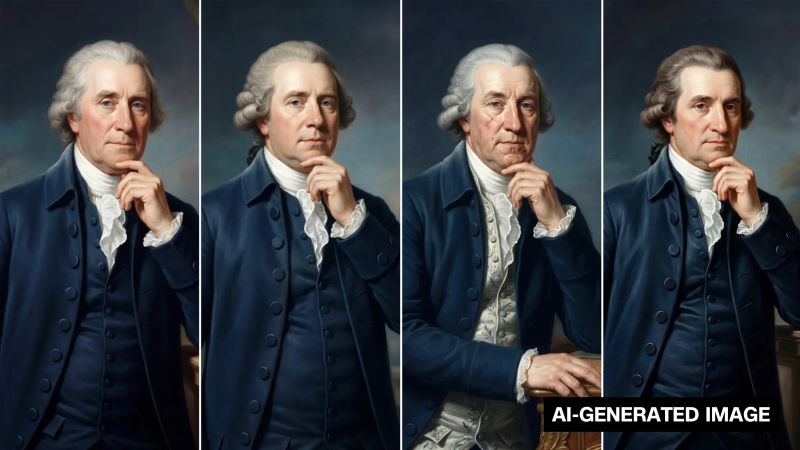
Trump’s Freedom 250 Redesigns Founding Fathers with AI Enhancements
Sandego.net – Amidst the commemoration of the 250th anniversary of American independence, a striking visual reinterpretation of the nation’s revolutionary figures has emerged. The Freedom 250 project, a nonprofit initiative spearheaded by the Trump administration, has employed artificial intelligence to revamp historical portraits of the Founding Fathers. These digital renderings, now displayed on the organization’s website, offer a modern twist on the past, blending historical accuracy with a sleek, stylized aesthetic that has sparked both admiration and critique.
A New Image of the Founders
Dr. Benjamin Rush, a physician, academic, and one of the original signatories of the Declaration of Independence, is among the figures reshaped by this AI-driven effort. His portrayal in the Freedom 250 gallery features a smooth, porcelain-like brow, glossy curls, and a serene, faint smile. His gaze is direct, his expression composed, and his eyes a striking methylene-blue hue—a stark contrast to the more realistic features of his 18th-century portraits. In historical depictions, Rush was often shown with flat hair and elongated facial features, but the AI-generated version presents a wholly different visage, one that seems to belong to a different era or even an entirely imagined person.
The project’s use of generative AI has created a sense of uniformity across the gallery. Each figure is rendered with a polished, almost idealized appearance, and the digital watermark identifying them as AI creations has become a recurring motif. This standardization extends beyond individual portraits, as noted by historian Zara Anishanslin of the University of Delaware, who has analyzed the project’s visual choices. “Many of the images appear to have roots in real portraits, but their details seem to have been altered to create a more corporate vision of American history,” she remarked. The result is a gallery that feels less like a tribute to the past and more like a curated display for the present.
The Ladies of the Revolution
While the focus of the project has largely been on male Founding Fathers, a subset of the gallery features four “Ladies of the Revolution.” These portraits, according to public historian Isabelle Roughol, exhibit anachronistic elements that challenge historical authenticity. For instance, Dolley Madison, a prominent figure in the Revolutionary War era, is depicted as an adult woman in the gallery. Yet, at the time of the revolution, she would have been just eight years old. This discrepancy has raised questions about the accuracy of the project’s representation of women’s roles in the founding period.
Abigail Adams’ AI portrait, in particular, has drawn attention for its exaggerated features. Her face is sculpted into a more rigid, youthful form, with oversized eyes and a taut, almost artificial expression. This stands in contrast to the 1766 pastel portrait of a 21-year-old Adams by Benjamin Blyth, which captures her as almond-shaped and slightly hooked-nosed, with a thin upper lip. The Freedom 250 version, however, seems to apply a digital rhinoplasty and lip filler, giving her a look that evokes an anime character rather than a 18th-century revolutionary. “What she doesn’t look like are any available images of Abigail Adams,” Roughol noted in a widely shared video, highlighting the uncanny transformation of the historical figure.
Stylistic Convergence and Modern Influences
The AI-generated portraits of the Founders exhibit a surprising convergence in style. Many share similar poses, such as arms crossed over the chest or fingers resting on their chins in contemplation—gestures that, while modern, are now attributed to the 18th century. This stylistic uniformity has been compared to contemporary CEO imagery, as Anishanslin explained. “It’s almost like modern CEO imagery that’s being grafted onto these 18th-century founders,” she said. The resemblance is further amplified by the choice of clothing, which favors blue coats and cravats—styles more commonly associated with the 19th century than the Revolutionary War era.
Historical portraits of figures like Benjamin Franklin often showcased a variety of garments, reflecting personal taste and regional fashion. The Freedom 250 version, however, features Franklin in a blue coat that mirrors the attire of 19th-century business leaders, rather than the gray coat he wore to symbolize republican simplicity in Duplessis’s 18th-century work. This shift suggests a deliberate effort to align the Founders with a more contemporary, polished image—one that resonates with the Trump administration’s vision of American history.
Even the decorative elements in the gallery reflect this modern sensibility. Neoclassical columns and banisters, which were popular in the 19th century, now frame the portraits, despite their rarity in Revolutionary-era portraiture. These choices, while visually striking, have led some to question whether the project prioritizes aesthetic appeal over historical fidelity. “The setting feels more like a corporate boardroom than a historical exhibition,” Anishanslin added, emphasizing the gap between the past and the present in the gallery’s design.
Reflections on AI and Historical Representation
As the Freedom 250 gallery continues to draw public attention, it has ignited discussions about the role of technology in historical storytelling. While AI allows for creative reinterpretation, it also risks overshadowing the nuances of individual identities. For example, the AI-generated Rush seems to diverge significantly from the historical record, with features that could belong to a different time period entirely. This raises the question: Does the use of AI enhance historical understanding, or does it impose a modern template on the past?
Public historians have noted that the project’s approach to the Founders may be more about creating a visually cohesive narrative than capturing their true likenesses. The standardized poses, repeated expressions, and uniform clothing choices suggest a desire for consistency and impact, rather than a faithful reproduction of historical details. This has sparked debates about the balance between innovation and accuracy in historical art. “The AI versions feel like they’ve been crafted for a specific audience,” Anishanslin observed. “They’re not just portraits; they’re brand ambassadors for the semiquincentennial.”
Despite these concerns, the project has been praised for its ability to engage a broader audience with historical figures. The use of AI has made the portraits more accessible, particularly to younger generations who may be more familiar with digital media. However, critics argue that the transformation of the Founders into a sleek, corporate archetype may dilute their individuality. “These portraits are more about creating a memorable image than a precise historical record,” Roughol said. “But that’s not necessarily a bad thing.”
The Future of Historical Portraiture
The Freedom 250 initiative marks a significant shift in how historical figures are portrayed. By leveraging AI, it offers a new way to visualize the past, blending technology with tradition. Yet, this approach also challenges the conventions of historical art, raising questions about the value of authenticity in a digital age. As the gallery expands, it will be interesting to see how these portraits are received by historians and the public alike. Whether they are seen as a bold innovation or a nostalgic reinterpretation, the AI-enhanced Founders are undeniably a product of their time—and a reflection of the era’s evolving relationship with history.
“It’s almost like modern CEO imagery that’s being grafted onto these 18th-century founders,” said Zara Anishanslin, a historian at the University of Delaware. “The portraits feel less like representations of the past and more like a carefully curated image for the present.”
Ultimately, the Freedom 250 project exemplifies the tension between historical accuracy and artistic reinterpretation. While it has reimagined the Founding Fathers in a way that aligns with contemporary visual culture, it has also sparked a conversation about the role of AI in shaping our collective memory. As the semiquincentennial celebrations continue, these portraits will serve as a reminder of both the power and the limitations of technology in preserving the past.