Homo Floresiensis: Scavengers, Not Hunters?
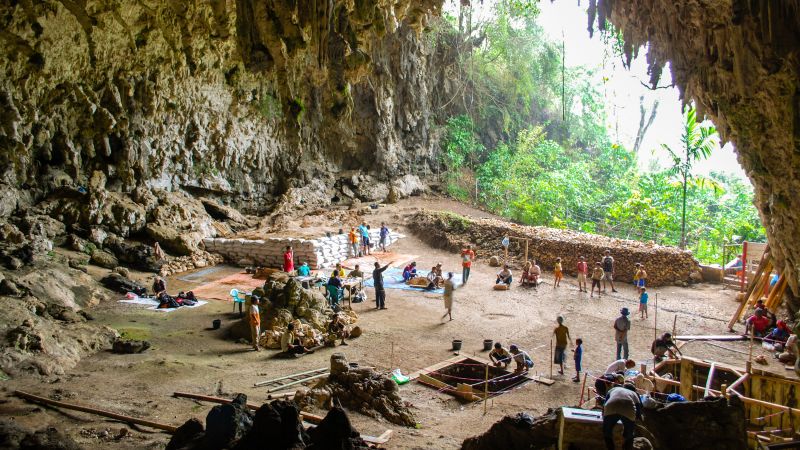
Sandego.net – Recent findings challenge long-held assumptions about the survival strategies of ancient human relatives, specifically Homo floresiensis, commonly known as the “hobbit.” These diminutive hominins, whose fossils were discovered in the Liang Bua cave on Indonesia’s Flores Island in 2003, may have relied on scavenging rather than hunting large animals or using fire to cook their food, according to new research. The study, published in *Science Advances*, sheds light on the daily lives of these early humans and their place in the broader narrative of human evolution.
The Discovery of a Unique Species
The fossils of Homo floresiensis, unearthed in 2003, revealed a species with a brain size comparable to that of a chimpanzee and a stature of approximately 3.3 feet (1 meter). This small-bodied hominin, which lived between 190,000 and 50,000 years ago, was initially thought to have hunted large herbivores like Stegodon florensis insularis, an elephant-like creature weighing around 1,260 pounds (570 kilograms) and standing about 5 feet (1.5 meters) tall. However, a new analysis suggests that their survival may have depended more on opportunistic feeding than on active hunting.
Archaeologists found stone artifacts and bones of Stegodon near the hobbit fossils, leading to speculation that these humans used tools to hunt the large animals. The presence of burned bones, in particular, was interpreted as evidence of fire use for cooking. Yet, these observations have now been reexamined through a fresh perspective, one that questions whether Homo floresiensis was as resourceful as previously believed.
Reassessing Tool Marks and Scavenging Behavior
Dr. Elizabeth Grace Veatch, a paleoanthropologist specializing in human diets and interactions with animals, spearheaded the study. Her team focused on analyzing how Stegodon bones were altered after the animals died, seeking clues about the tools and techniques used by Homo floresiensis. “I wanted to see if we could definitively show that H. floresiensis was the hunter it had been portrayed as for decades,” Veatch explained in an email. The results, however, point toward a different conclusion.
“I was surprised by how similar most of the marks were to our Komodo dragon sample.”
The researchers conducted an experiment involving a Komodo dragon named Rinca at Zoo Atlanta, observing how the lizard fed on a goat carcass. By comparing the tooth marks left on bones by the dragon with those made by human tools, they aimed to determine whether the hobbits were responsible for the cuts on the Stegodon remains. The analysis revealed that Komodo dragon tooth marks were predominantly found on the most nutritious parts of the animal, such as the ribs and thigh bones. In contrast, the cut marks from the hobbits’ tools were concentrated on less valuable sections, like the legs and lower spine. This distribution implies that the hominins were not actively hunting the Stegodon but instead scavenging the leftovers after the dragons had consumed the meat.
Veatch and her colleagues hypothesize that Homo floresiensis may have lived in proximity to Komodo dragons, taking advantage of the predators’ leftovers. This behavior aligns with the idea that the hobbits used their stone tools to strip meat from bones, rather than engaging in the complex task of hunting. The study also notes that the hobbits likely avoided the risk of venom poisoning, as Komodo dragon venom contains proteins that are neutralized by the acidic environment of the stomach, a defense mechanism that would have protected them from harm.
Implications for Human Evolution
The findings contribute to a growing body of evidence that Homo floresiensis was not as advanced as earlier theories suggested. While they crafted tools and utilized them for processing meat, these actions may have been simpler than those of other hominin species. For instance, the use of fire, which is considered a hallmark of human evolution, appears to be less central to their survival strategy. The presence of burned bones might have been the result of accidental exposure to heat rather than intentional cooking.
Briana Pobiner, a coauthor of the study, highlighted the abundance of stone tools found alongside the hobbit fossils. These tools, made from local chert, were likely used to break open bones and extract marrow, a high-energy food source. However, the researchers argue that the tools’ primary function may have been for scavenging rather than hunting. “Thousands of tools have been found near the fossils, suggesting the early hominins were crafting what they needed to process Stegodon meat,” Pobiner noted. Yet, the distribution of marks on the bones indicates that the tools were not used for killing the animals, but for cutting and extracting meat after the animals had been consumed by other predators.
This revelation raises questions about the cognitive abilities of Homo floresiensis. While their brain size is modest compared to other hominins like Neanderthals or Homo sapiens, the tools they created demonstrate a level of dexterity and planning. However, the study suggests that these skills may have been sufficient for scavenging rather than for hunting or cooking. The implications are significant: if Homo floresiensis relied on scavenging, their evolutionary trajectory may have diverged from that of other humans in ways previously unconsidered.
The Role of Predators in Survival
Komodo dragons, the sole carnivores on Flores Island, played a critical role in shaping the hobbits’ diet. These lizards, which can grow up to 10 feet (3 meters) long and weigh over 300 pounds (135 kilograms), are known for their powerful bite and venomous saliva. The study suggests that the hobbits may have exploited the dragons’ hunting patterns, much like modern animals that scavenge after predators have fed. By examining the tooth marks on Stegodon bones, researchers were able to determine that the dragons primarily targeted the most nutrient-rich areas, leaving behind bones that the hobbits could then access.
The team used 3D scanning to analyze the goat bones from Rinca’s meal, creating a detailed record of the damage caused by the dragon’s teeth. This technique allowed them to compare the marks with those found in the Liang Bua cave, revealing striking similarities. The pattern of marks indicates that the dragons’ feeding behavior was the dominant force in shaping the Stegodon remains, rather than human activity. This discovery supports the theory that Homo floresiensis was a passive consumer of the island’s resources, relying on the dragons’ hunting to provide sustenance.
Revisiting the Family Tree of Human Evolution
The research also sparks debate about the evolutionary relationships of Homo floresiensis. Some scientists had previously proposed that the species was closely linked to Homo erectus, an early human that lived between 1.89 million and 110,000 years ago. The tools and scavenging behavior observed in the hobbits may align with this hypothesis, as Homo erectus is known to have used tools for processing meat and bone. However, the study’s findings suggest that Homo floresiensis may have evolved independently, adapting to the island’s unique ecological conditions through a combination of tool use and scavenging.
Veatch emphasized that the new evidence shifts how experts view the hobbits’ place in human history. “The combination of these findings with earlier research challenges the idea that they were advanced hunters,” she said. Instead, the study paints a picture of a species that thrived in an environment where competition with large predators was necessary. Their survival may have depended on their ability to quickly access food left behind by dragons, rather than on the physical strength or cognitive complexity required for hunting.
This revised understanding of Homo floresiensis highlights the importance of context in interpreting ancient behaviors. While their brain size is small, their tools and resourcefulness suggest a level of adaptability. The study underscores the need to consider environmental pressures and ecological interactions when evaluating the capabilities of early human relatives. As research continues, the hobbits may yet reveal more about the diverse ways in which humans and their ancestors adapted to survive in isolated habitats.
Ultimately, the findings offer a fresh perspective on the evolutionary timeline, demonstrating that not all hominins followed the same path. The connection between scavenging and survival, as seen in Homo floresiensis, may provide insights into how other early species, such as Homo erectus or even earlier hominins, managed to thrive in challenging environments. The study’s implications extend beyond the hobbits, encouraging a broader reassessment of the tools, behaviors, and cognitive abilities that defined our ancient ancestors.