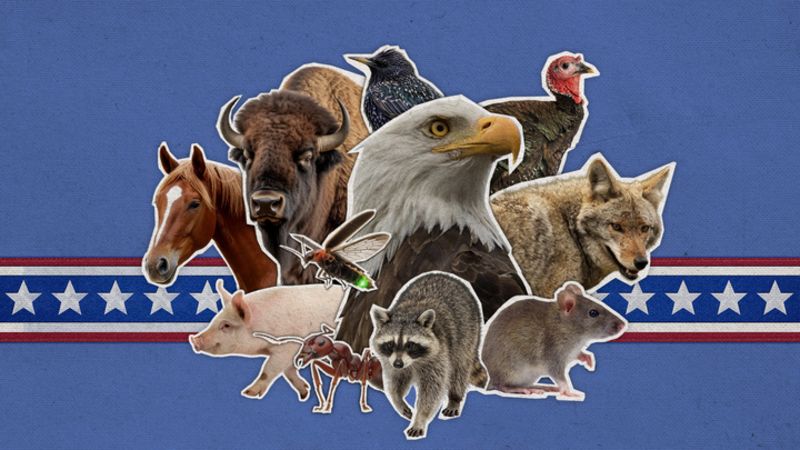
What is the most American animal?
Sandego.net – In the early days of the United States, the selection of a national emblem was more than just a symbolic gesture—it was a deliberate act of identity. In 1782, a relatively obscure figure in American history, Charles Thomson, fastened a shield to a bald eagle, its claws clutching arrows and olive branches, and presented it as the Great Seal. This choice marked a pivotal moment in shaping the visual language of a young nation. Yet, the decision was not without controversy, as some of the nation’s founding thinkers questioned whether the eagle truly embodied the ideals they sought to represent.
A Debate Over Symbols
Among the critics was Benjamin Franklin, who famously argued that the eagle in the design seemed more like a “rank coward” compared to the turkey, a bird he described as “a bird of courage.” Franklin’s preference for the turkey reflects a broader tension between the practical and the symbolic in the formation of national identity. At the time, the Great Seal had to overcome three earlier attempts, including a dramatic suggestion inspired by biblical imagery. The eagle, however, emerged as a fitting choice, not just for its regal appearance but for its presence across the 13 original colonies.
“When animals become symbols, they often cease being animals,” said Janet M. Davis, a professor of American studies at the University of Texas at Austin. “They become ideological repositories, representations of nebulous values like freedom and strength, players in our national mythology.”
Though the eagle was already a common sight in the wild, its symbolic transformation allowed it to transcend its natural role. Over time, it became an abstraction, a recurring image on everything from pocket change to mailbox poles. This iconic status, however, has raised questions about its relevance in modern times. As the nation approaches its 250th anniversary, some wonder whether the eagle, chosen hastily in the 18th century, still accurately represents the country’s evolving identity.
The Eagle’s Evolution
Charles Thomson’s eagle, Haliaeetus leucocephalus, was a native North American species with a vast range. It spanned all 13 colonies and later extended to Alaska, making it a natural fit for a nation seeking to connect with its own land. Yet, its symbolic journey has been as much about human interpretation as its physical survival. During the Civil War, for instance, the eagle became a mascot for the 8th Wisconsin Volunteer Infantry Regiment, accompanying soldiers into battle as a symbol of martial pride. This dual role—both as a living creature and a cultural icon—has cemented its place in American history.
However, the eagle’s image has often overshadowed its real-world presence. In the 19th century, the bird was nearly wiped out by human activity. Hunters decimated populations, and habitat destruction, along with the use of harmful pesticides like DDT, pushed the species to the brink. By the early decades of the Bicentennial, only 417 nesting pairs remained, a stark contrast to the estimated 100,000 to 300,000 that once roamed the country. This decline has led some to question whether the eagle’s symbolic weight has outpaced its ecological reality.
“The bald eagle’s comeback can be seen as a testament to American persistence and redemption,” said Jack E. Davis, a Pulitzer Prize-winning author and environmental history professor at the University of Florida. “It’s not just about survival—it’s about how we choose to value and protect what we once thought lost.”
Despite its struggles, the bald eagle has made a remarkable recovery. Conservation efforts, including the Endangered Species Act and the ban on DDT, have helped restore its numbers to over 300,000 today. The Department of the Interior has even called this resurgence “the greatest triumph in the history of American wildlife conservation.” Yet, the bird’s revival is not without its challenges. In Big Bear Valley, for example, a development project threatens to disrupt nesting sites, highlighting the ongoing balance between human progress and wildlife preservation.
Redefining the American Experience
As the nation celebrates its 250th year, the question arises: does the bald eagle still resonate as the most American animal? Or has it become a relic of an older era? Some experts argue that the eagle’s symbolism, while powerful, may no longer capture the complexity of contemporary America. Others suggest that the bird’s resilience mirrors the country’s own capacity to overcome adversity, making it a fitting representation of national character.
The debate extends beyond the eagle. Ecologists and wildlife biologists emphasize the importance of considering the diverse fauna that coexists with humans. From the prairie dog to the gray wolf, the United States is home to a vast array of species that reflect its landscapes and cultures. Yet, the eagle remains a unifying figure, its image a constant thread through American history. “The eagle’s symbolism has endured because it encapsulates a vision of power and freedom,” Davis explained. “It’s a reminder that even the most iconic symbols can evolve, but their core essence remains tied to the nation’s values.”
While the eagle may have been a symbol of dominance in the past, its modern role is more nuanced. In recent years, it has come to represent not just strength but also the capacity for renewal. The success of its comeback, in particular, has been framed as a metaphor for American resilience. As the president recently showcased an AI-generated image of a golden eagle hanging from a White House balcony, the debate over symbols continues. Is the eagle still the most American animal, or does the question require a new answer?
Choosing a New Symbol
Experts in American history and identity have been asked to nominate a most American animal for the 21st century. Some refuse, citing the nation’s rich biodiversity as a reason to resist a single symbol. Others argue that the eagle’s legacy is too strong to be replaced, even as they acknowledge the merits of other candidates. For example, the prairie dog’s adaptability to human-altered landscapes, or the beaver’s role in shaping the nation’s rivers, could offer alternative narratives.
Yet, the eagle’s ability to adapt—both in the wild and in culture—suggests it remains a relevant choice. Jack E. Davis noted that the bird’s survival story, despite its scavenging habits and occasional theft of fish, mirrors America’s own journey. “We aren’t perfect, but the eagle’s persistence speaks to the spirit of the country,” he said. “It’s a reminder that even the most vulnerable species can become symbols of triumph.”
As the eagle continues to soar in both physical and cultural realms, its status as the most American animal remains a topic of discussion. Whether it is seen as a fitting emblem or a relic of the past, its story is intertwined with the nation’s history. From the Founding Fathers to modern conservationists, the bird has been a silent witness to the evolution of American identity. Its survival—and the myths that surround it—underscore a fundamental truth: symbols, like animals, are shaped by the people who choose them and the values they represent.
What does the bald eagle say about 2026? According to Davis, it’s a story of resilience, both in the natural world and the human experience. “The eagle’s comeback is a mirror of our own,” he said. “It proves that with effort, even the most endangered symbols can find a new place in our collective story.” This duality—between the animal and its image—invites reflection on how America defines itself. Is it through the grandeur of its symbols, or through the everyday lives of its wildlife? The answer, perhaps, lies in the continued coexistence of both.