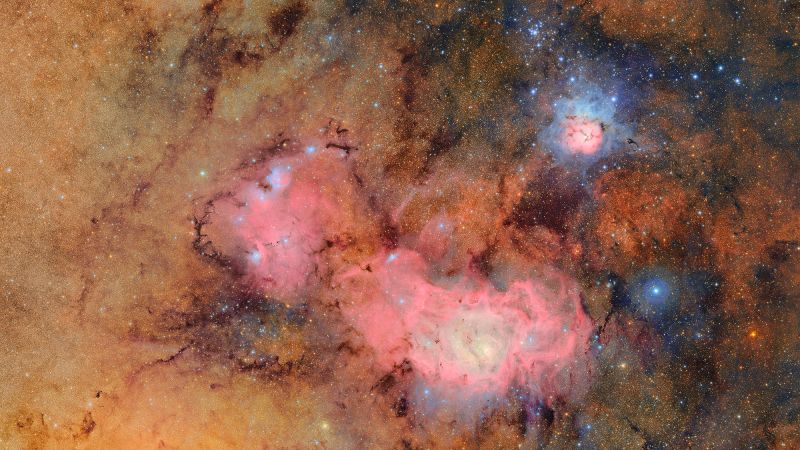
The greatest cosmic movie ever made’: Historic telescope kicks off an unprecedented survey
Sandego.net – For the next 10 years, a massive camera the size of a small car will begin capturing detailed images of the southern sky every 40 seconds during the night. This continuous effort, known as the Legacy Survey of Space and Time (LSST), marks a transformative moment in astronomical research, as it aims to create a dynamic record of the universe’s evolution. The Vera C. Rubin Observatory in Chile, home to the world’s largest digital camera—weighing 6,600 pounds—has officially started this groundbreaking mission, offering a new perspective on celestial phenomena. By compiling thousands of images over time, the survey will provide a time-lapse of how stars, galaxies, and cosmic events change, potentially revealing answers to enduring mysteries about the cosmos.
A Vision of Cosmic Clarity
The LSST’s camera, equipped with advanced filters, will simulate superhuman vision as it scans the sky nightly. These filters allow the telescope to capture a wide spectrum of light, revealing details that would otherwise be invisible. This capability is crucial for tracking the movement and transformation of objects ranging from asteroids to supernovae. The images produced will not only document the current state of the universe but also highlight its history, enabling scientists to study how celestial structures evolve over time. The project’s ability to revisit the same areas of the sky repeatedly ensures a comprehensive dataset, with each revisit adding layers of insight into the dynamic nature of space.
“Today, we begin filming the greatest cosmic movie ever made,” said Brian Stone, who is currently fulfilling the duties of the US National Science Foundation director. “This moment reflects decades of vision, innovation and the power of federal investment.”
According to a recent news release, the LSST will provide a “color-rich” view of explosive events like supernovae, as well as cosmic collisions and black holes. These images will act as a beacon for other observatories globally, prompting coordinated efforts to analyze significant celestial occurrences. The collaboration between institutions will enhance the depth of understanding, allowing for a more holistic exploration of the universe’s secrets.
Unveiling the Universe’s Hidden Layers
The observatory’s decade-long study has several key objectives. It aims to create a fresh catalog of objects within our solar system and the Milky Way, as well as to investigate the enigmatic nature of dark matter by examining the light bending caused by massive cosmic structures. By observing the subtle distortions in distant galaxies, scientists hope to uncover clues about the unseen forces shaping the universe. Additionally, the survey will catalog rare events, such as gamma-ray bursts and transient astronomical phenomena, which are typically difficult to detect.
Located on the 8,800-foot summit of Cerro Pachón in northern Chile, the Rubin Observatory benefits from ideal stargazing conditions. The site’s dark skies and arid climate make it one of the most optimal locations for astronomical observation. This strategic placement ensures minimal atmospheric interference, allowing for high-quality images that will be vital to the project’s success. The observatory’s construction, funded jointly by the US National Science Foundation and the Department of Energy, has required significant investment to realize its ambitious goals.
Overcoming Delays to Achieve Breakthroughs
Although the LSST was anticipated to begin by early 2026, the process of system testing and optimization took longer than expected. Željko Ivezić, the head of LSST, explained that the decision to officially launch the survey followed a thorough evaluation of technical readiness, data system performance, and scientific validation. Key factors influencing this decision included image clarity, survey speed, system uptime, and precise calibration. These standards ensure that the data collected will be both accurate and reliable, forming the foundation for groundbreaking discoveries.
Once operational, the telescope will capture thousands of images each night, completing a full scan of the southern sky every few days. This rapid data collection will generate a vast archive, with the ability to revisit specific regions multiple times. Such a method allows scientists to track subtle changes, from the slow movements of distant galaxies to the sudden bursts of light from supernovae. The resulting dataset will offer an unprecedented view of cosmic activity, making it a cornerstone of modern astrophysics.
Unlocking the Future of Astronomy
As the LSST progresses, researchers will employ artificial intelligence and machine learning to sift through the enormous volume of data. These technologies will help identify patterns and anomalies, such as unusual stellar behaviors or previously undetected celestial objects. The observatory is expected to generate approximately 7 million alerts each night, signaling interesting phenomena like asteroid movements, exploding stars, or unusual cosmic events. This real-time data will empower both professional and amateur astronomers to explore the universe in ways previously unimaginable.
Before the full survey begins, the observatory has already made notable progress. During earlier testing phases, it has detected over 11,000 new asteroids and identified dozens of other objects in our solar system. These findings underscore the project’s potential to revolutionize our understanding of the cosmos. When completed, the final dataset will contain billions of celestial objects and trillions of measurements, all accessible through regular data releases. This unprecedented access to astronomical data will open doors for new discoveries, fostering a collaborative environment where scientists and the public can contribute to unraveling the universe’s mysteries.
The LSST represents more than just a technical achievement—it is a testament to the power of sustained scientific investment. By combining cutting-edge technology with a global network of observatories, the mission will generate a continuous stream of insights into the universe’s past, present, and future. As the time-lapse of the cosmos unfolds, researchers are poised to uncover phenomena that could reshape our understanding of the universe’s fundamental forces and its vast, uncharted territories.
For those eager to stay updated on the latest cosmic revelations, signing up for CNN’s Wonder Theory science newsletter offers a window into the universe’s most fascinating discoveries. From advancements in astrophysics to breakthroughs in space exploration, this initiative ensures that the public remains engaged with the ongoing journey of uncovering the universe’s secrets.