Serena Williams’ Wimbledon Return Felt Special and Yet Strangely Familiar
Sandego.net – In 2022, Serena Williams exited Wimbledon’s Centre Court with uncertainty about her future. After a first-round loss to France’s Harmony Tan, the American tennis icon found herself at a crossroads, with doubts about her longevity in the sport circulating among fans and analysts in London. At 40, the legendary player had been sidelined by persistent injuries, her world ranking plummeting to 1,204th. Her absence from the grand slam title scene stretched over five years, leaving her to feel like a distant memory on the grass courts. “That’s a question I can’t answer. I don’t know,” she said at the time, uncertain about her future. “Who knows where I’ll pop up?”
Now, over 1,000 days later, the answer was clear. She was not done at Wimbledon. The world had evolved since her last appearance, yet the familiarity of the scene was unmistakable. As the now-44-year-old stepped onto Centre Court for her first singles match since the US Open in 2022, the air buzzed with anticipation. Her return was more than a mere event—it was a testament to her enduring presence in the sport, even as the game around her continued to shift.
The atmosphere was electric, with fans from every corner of the globe gathered to witness her every move. Despite the massive crowd and millions watching globally, Williams remained composed, her demeanor calm and unassuming. She didn’t greet the spectators with grand gestures, nor did she linger on the court. Her focus was singular, eyes fixed on the ground, headphones on, as if the world’s expectations were just another layer of noise. “It was really great to be back at Wimbledon. I never expected to be here,” she later reflected, her voice carrying a mix of gratitude and surprise. “The atmosphere was amazing. Walking out was amazing. I definitely relished it and missed it and enjoyed the moment more than anything.”
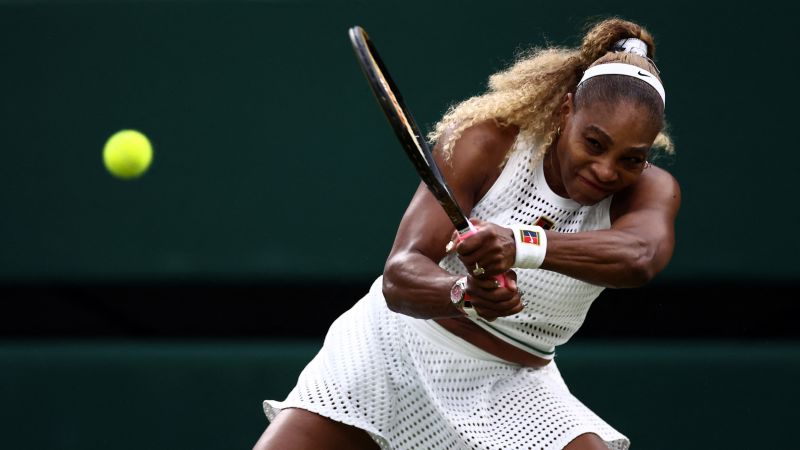
The match itself was a blend of struggle and brilliance. Williams began with a ferocious intensity, her serve returning with such force that her 20-year-old opponent, Maya Joint of Australia, seemed momentarily overwhelmed. For a brief moment, it felt as though the 23-time grand slam singles champion had never been away, her strokes sharp and her presence commanding. The roof of Centre Court, closed for the day, amplified every crack of her racket, creating a symphony of sound that echoed through the stadium. Fans could close their eyes and instantly recognize the signature power of her ground strokes or the blistering speed of her serves, which occasionally reached over 120 mph. Her trademark grunts and roaring celebrations, which had become synonymous with her career since her debut nearly 30 years ago, returned with the same vigor.
Yet, the rust of inactivity was evident. Not every shot was precise, and her timing occasionally faltered, hinting at the challenges of reacclimating to the sport after such a prolonged hiatus. By the end of the first set, she had already faced the threat of a straight-sets defeat, her opponent capitalizing on her tentative moments. But as the match progressed, Williams’ resilience shone through. The turning point came in the second set, when she found herself a set and a break down. According to Wimbledon’s analytics, her chances of reclaiming the match were less than 5%, a statistic that seemed to fuel her determination.
“It was really great to be back at Wimbledon. I never expected to be here,” Williams said post-match. “The atmosphere was amazing. Walking out was amazing. I definitely relished it and missed it and enjoyed the moment more than anything.”
In that moment of despair, Williams transformed. Her body, as if programmed by years of experience, shifted into a state of near-perfect efficiency. She imposed her will on the game, her opponent struggling to keep pace. The crowd, initially reserved, erupted when she clinched the second set, sending the match into a decisive third. Her raw talent was undeniable, with moments of brilliance that elicited standing ovations from spectators. However, the final set proved to be a test of endurance, and though she fought valiantly, the match ended with a hard-fought loss.
Despite the defeat, the return was a triumph in itself. The world had moved on, yet the essence of her Wimbledon legacy remained intact. For decades, the tournament had been a stage for her dominance, with seven singles titles, countless doubles victories, and a mixed doubles crown adding to her legacy. Even in her 44th year, the same magnetism drew crowds, as if the grass courts had a way of summoning her every time.
The anticipation for her comeback had been building for months. Her unexpected return in the doubles draw at the Queen’s Championships earlier that year signaled a shift in her trajectory. Fans, who had wondered if she would ever return to the grand slam stage, now saw her as a contender once more. The tickets for Centre Court had already been sold out before her confirmation, a testament to her enduring appeal.
Walking through the grounds on the day of her match, the sheer volume of fans and media created a sea of excitement. Her name was on everyone’s lips, with conversations revolving around her every possible return. The pressure was palpable, but Williams carried herself with the same grace and determination that had defined her career.
Her performance, though not flawless, was a reminder of her greatness. The match was a microcosm of her journey—both the struggle and the triumph. She had faced the odds, battled through the uncertainties, and emerged to reclaim her place in the spotlight. Even in defeat, the moment was celebrated, as if her mere presence on the court was enough to inspire.
The final score—6-3, 6-7(6), 6-3—was a narrative of perseverance. It spoke to the resilience of a player who had weathered injuries, age, and doubt. While the result might not have been the victory she envisioned, the story of her return was one of hope and rejuvenation. For the tennis world, it was a reminder that Serena Williams, the Queen of the Game, had not only returned to Wimbledon but had done so with the same flair and flair that had once made her unstoppable.