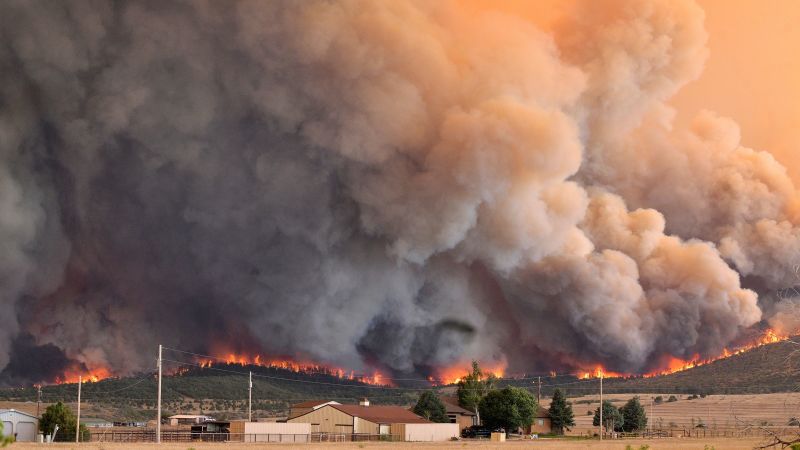
Wildfires Ignite Across the Western U.S., Spreading Rapidly Amid Drought and High Winds
Sandego.net – Multiple states in the western United States are grappling with a surge in wildfires, which have already consumed thousands of acres and displaced entire communities. The blaze, which has escalated swiftly, is being driven by an unusual combination of environmental factors: extreme low humidity, parched vegetation, and fierce winds. These conditions have not only accelerated the spread of existing fires but also triggered new outbreaks in central regions of the West. As the situation worsens, authorities have issued red flag warnings—a critical alert system designed to signal heightened fire risk—spanning large areas of Colorado and Utah, as well as parts of Arizona, New Mexico, Wyoming, and Nebraska. Another wave of such warnings is anticipated in Colorado and Utah on Wednesday, indicating that the fire-prone environment will persist for the foreseeable future.
Emergency Evacuations and Fire Threats
Residents in southern Colorado have been forced to evacuate as the Aspen Acres Fire, which erupted on Monday, continues to expand. Within hours of its ignition, the fire had already surpassed 23,000 acres, prompting widespread displacement. By Tuesday afternoon, officials reported that the blaze had scorched 28,000 acres and destroyed at least 155 structures. The danger is not limited to Colorado; neighboring areas in Pueblo and Custer counties are also under evacuation orders, with the fire’s growth threatening to engulf more land. Pueblo County Sheriff David Lucero highlighted the ongoing challenges, noting that while improved weather conditions helped curb the fire’s spread early Tuesday, afternoon winds posed a fresh risk to containment efforts.
“We owe it to the firefighters on the front lines to prevent new fires from starting,” said Colorado Gov. Jared Polis during a Monday press conference. He emphasized the importance of public vigilance, especially as many counties have implemented fire restrictions ahead of the Fourth of July holiday. These measures include bans on fireworks, which remain a common cause of accidental ignitions.
Meanwhile, the Snyder Fire along the Utah-Colorado border has become a tragic focal point. Three firefighters lost their lives in a sudden surge of flames, according to the U.S. Wildland Fire Service. The crew was overwhelmed by the fire’s intensity, leaving no room for escape. Two others sustained injuries during the same incident. This incident has underscored the perilous nature of the current fire season, with officials describing the conditions as “particularly dangerous” in the Salt Lake City area. Last week, the National Weather Service issued its first-ever “particularly dangerous situation” red flag warning for central and southern Utah, a rare designation that highlights the severity of the risk.
Historical Context and Fire Impact
Utah is facing its most destructive fire season in decades, with the Cottonwood Fire in southern Utah expanding to nearly 100,000 acres as of Tuesday night. That area, larger than Salt Lake City itself, is only 5% contained, according to InciWeb data. Alyssa Mason, a spokesperson for the Great Basin Team 5, noted that assessments are still ongoing, and crews anticipate discovering additional losses. The fire’s economic and human toll is significant, with an estimated 150 structures already lost.
Historically, the 2018 Dollar Ridge Fire was considered the most damaging in Utah’s history, destroying 74 homes. However, the Cottonwood Fire now threatens to surpass that record, with officials warning of its potential to become the state’s costliest and most devastating blaze. Karl Hunt, a public affairs officer with the Utah Division of Forestry, Fire, and State Lands, remarked that the current fire situation is unprecedented in scale and speed. The region’s prolonged drought, exacerbated by climate change, has created a tinderbox environment, where even a small spark can ignite catastrophic flames.
Further southeast, the Babylon Fire has prompted the Manti-La Sal National Forest to issue an emergency closure, restricting access to affected areas. This closure underscores the severity of the threat, as the fire continues to burn with little sign of slowing. Across the state, evacuations have been ordered for regions impacted by the Willow Fire in Lake County and the Gold Mountain Fire in Ouray County, with additional fires emerging in unexpected locations. The sheer volume of activity has strained firefighting resources, requiring coordinated efforts between local, state, and federal agencies.
The U.S. Forest Service – Fishlake National Forest reported progress in containment efforts on Tuesday, thanks to favorable weather conditions. However, the long-term outlook remains grim, as high temperatures and dry winds are expected to intensify throughout the week. “Conditions during a red flag warning can turn small fires into major disasters in a matter of hours,” warned the service, emphasizing the need for continued vigilance. With twelve active fires now covering nearly 300,000 acres, the region is on high alert, and the risk of further devastation is rising.
“We owe it to the firefighters on the front lines to prevent new fires from starting,” said Colorado Gov. Jared Polis during a Monday press conference. He emphasized the importance of public vigilance, especially as many counties have implemented fire restrictions ahead of the Fourth of July holiday. These measures include bans on fireworks, which remain a common cause of accidental ignitions.
Evacuations and emergency declarations are now part of the daily routine in Colorado, with sixteen wildfires burning as of Monday night. The most severe of these is the Snyder Fire, which has consumed over 30,000 acres and prompted emergency declarations in Mesa County. Polis also authorized the deployment of the state’s National Guard to assist in response efforts, highlighting the scale of the crisis. The combination of climate-driven conditions and human activity has created a perfect storm, where wildfires are not only spreading faster but also causing more damage than ever before.
As the fires continue to burn, the focus remains on containing them while protecting lives and property. Firefighters are working tirelessly, but the unpredictable nature of the weather and the vast areas affected make this a challenging task. The recent loss of life in the Snyder Fire serves as a stark reminder of the dangers faced by those on the front lines, with officials calling them “unsung heroes” in the fight against the blazes. Despite their efforts, the situation shows no signs of abating, and the western United States is poised for a prolonged period of intense fire activity.
The broader implications of this fire season extend beyond immediate damage. Experts warn that the increasing frequency and severity of wildfires are linked to long-term climate trends, including rising temperatures and shifting precipitation patterns. This year’s events are a harbinger of what may become the new normal, requiring updated strategies for fire prevention, response, and recovery. As the region braces for more dangerous weather in the coming days, the race to control these wildfires is intensifying, with communities and emergency teams preparing for the worst.