Philadelphia’s Stand Against Trump’s Efforts to Alter Slavery Exhibit at National Park
A Historic Site in Peril
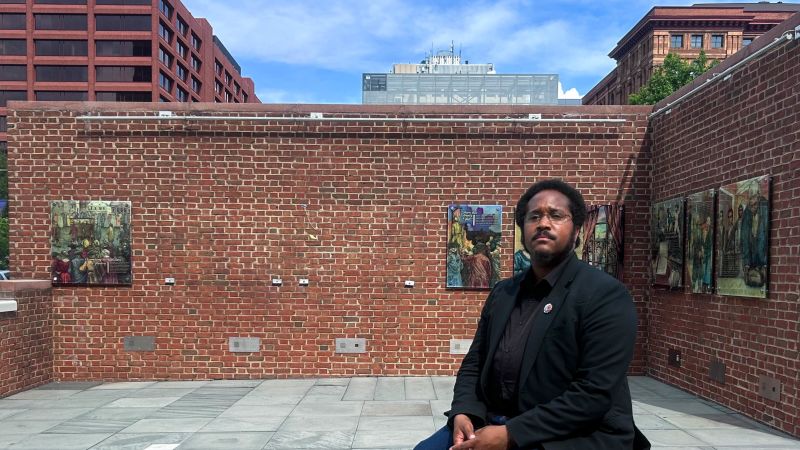
Sandego.net – As the United States approached its 250th anniversary, the nation’s birthplace in Philadelphia stood as a symbol of both freedom and its complex history. Yet, just a short distance from the Independence Hall and the Liberty Bell, a section of Independence National Historic Park remained incomplete, a casualty of a prolonged legal dispute. Mijuel Johnson, a local guide with The Black Journey, described the scene as “a living historical moment,” emphasizing the tension between past and present as visitors navigated the site.
The Trump Administration’s Campaign to Rewrite History
Philadelphia’s struggle against the Trump administration reflects a broader effort to reshape historical narratives in line with political priorities. The conflict centered on an exhibit at the President’s House, a lesser-known open-air site within the park, which highlighted the lives of enslaved individuals tied to George Washington. For over a decade, this exhibit had served as a reminder of the nation’s founding paradoxes, blending the achievements of the Founding Fathers with the realities of slavery.
President Donald Trump’s executive order, “Restoring Truth and Sanity to American History,” initiated a nationwide campaign to revise content in cultural institutions. The directive aimed to eliminate material that “inappropriately disparage Americans past or living,” prompting the Department of Interior to target the Philadelphia exhibit. This move sparked a legal battle that would span multiple courts and escalate into a federal showdown.
The Legal Battle and Its Turning Points
In January, CNN affiliate WPVI captured footage of workers dismantling large display panels at the site using crowbars. The city of Philadelphia swiftly responded by filing a lawsuit to block the federal government’s alterations. The initial court ruling in February favored the city, with Judge Cynthia Rufe stating, “This Court is now asked to determine whether the federal government has the power it claims — to dissemble and disassemble historical truths when it has some domain over historical facts.” She concluded, “It does not.”
However, the Trump administration appealed the decision, and the legal saga continued. On June 18, a panel of three judges from the Third Circuit Court of Appeals unanimously sided with the Department of Interior, overturning the earlier ruling. The court found that Philadelphia no longer held ownership of the President’s House site and that the revised exhibit “was full of historical context.”
According to the opinion authored by Thomas Hardiman, a George W. Bush appointee, the new panels “acknowledge the evil of slavery, including its injustices and hypocrisies, and, by telling the story of the nine slaves that Washington kept in the President’s House, remind us of their essential humanity.” Despite this, advocates for the original exhibit argued that the revised version softened the harsh realities of slavery and downplayed Washington’s complicity.
Legacy and Resistance
The original exhibit, a collaboration between the city and the National Park Service, featured a timeline of American slavery and emphasized the lived experiences of nine enslaved individuals who worked in Washington’s Philadelphia household. One panel noted that Washington “oversaw more than 300 enslaved people, nine of whom served in his Philadelphia household,” linking his presidential duties to the exploitation of human labor.
Johnson, reflecting on the court’s decision, expressed cautious hope. “Hopefully when all of this is put back up, we might be able to add something talking about this part of the history of the memorial,” he said, referencing the battle as a pivotal moment in the site’s legacy. The dispute, he argued, should itself become a memorial, underscoring the importance of preserving historical truth even in the face of political pressure.
The city’s decision to sue was not merely about preserving a single exhibit. It represented a broader commitment to ensuring that the narrative of slavery remained central to the nation’s historical discourse. “This isn’t just about a few panels,” Johnson explained. “It’s about how we remember the full story of the United States — one that includes both the triumphs and the tragedies.”
Uncertain Outcome, Persistent Activism
As of now, the future of the exhibit remains uncertain. The Trump administration’s revised panels, which emphasize historical context but downplay the brutality of slavery, are still in place. The city, however, continues to push back, advocating for a more comprehensive representation of the site’s history. Johnson, though acknowledging the government’s arguments, remains resolute. “We’ll keep fighting until the history is told as it was,” he said.
The dispute has galvanized local communities and historians, sparking debates about the role of public institutions in preserving cultural memory. While the federal government claims the exhibit now reflects a balanced view of history, critics argue that the revisions have created a more sanitized narrative. “They’ve taken away the urgency of the past,” one advocate noted, “and replaced it with a version that feels more like a political statement than a historical record.”
The President’s House, once a quiet corner of the park, now serves as a battleground for competing interpretations of American history. The original exhibit’s removal has left a void, but it has also ignited renewed efforts to document and celebrate the contributions of enslaved people to the nation’s founding. “History is not static,” Johnson remarked. “It evolves, but we must ensure it doesn’t get erased.”
With the federal government’s final decision pending, the fate of the exhibit hangs in the balance. For Philadelphia, the fight is far from over. The city’s determination to reclaim its historical narrative mirrors a growing movement across the country to protect marginalized voices in the national story. As the nation marks its 250th year, the question remains: how will its history be remembered, and who gets to decide?
A Call for Historical Integrity
Supporters of the original exhibit stress the importance of presenting slavery as a foundational element of American history. They argue that the revised panels, while well-intentioned, fail to capture the full scope of the institution’s impact. “We need to show the suffering, the resistance, and the resilience of those who were enslaved,” said a local historian. “It’s not enough to mention their existence — we must honor their humanity.”
Meanwhile, the Department of Interior maintains that its revisions provide a more nuanced perspective, acknowledging the complexities of historical interpretation. The new exhibit highlights the evolution of slavery from a system of forced labor to a societal institution, while also recognizing the Founding Fathers’ roles in its perpetuation. Yet, for many, the debate over the exhibit is more than academic — it is a fight for the soul of history itself.
As the legal proceedings continue, the President’s House remains a focal point of national conversation. Whether the exhibit will be restored, removed, or replaced hinges on the federal government’s final decision. For now, the city of Philadelphia stands ready, its resolve unshaken. “We’ll keep pushing back,” Johnson said. “Because the truth is worth fighting for.”
In a nation that prides itself on liberty, the struggle to preserve the full truth of its history is both a challenge and a testament to the enduring power of memory. The battle over the Philadelphia slavery exhibit is not just about a single moment in time — it is a reflection of how history is shaped, contested, and redefined in the ever-changing landscape of American identity.