How Trump’s takeover fractured America’s birthday party
Sandego.net – As planners for the Next250 initiative prepared to mark the 250th anniversary of American independence, they imagined a moment of unity across a fractured nation. The event was meant to celebrate democracy, bridging divides in a country often split by ideological chasms. But the return of Donald Trump to the presidency, now in his second term, shifted the focus of the commemoration. What was once a collaborative effort has become a platform for Trump’s vision, drawing sharp criticism from those who see the anniversary as a symbol of collective pride rather than partisan triumph.
A Capitol Clash of Ideals
On Saturday, a vibrant gathering in Washington, DC, will showcase a blend of cultural and civic activities, including an indigenous ceremony and a march beginning at the site of Black Lives Matter Plaza. Voter registration booths will also be set up, emphasizing civic engagement. However, these efforts stand in stark contrast to the “Great American State Fair” taking place on the National Mall, a flagship event organized by Trump’s new initiative, Freedom 250. The clash between the two events highlights the growing ideological rift over how the nation’s founding is being celebrated.
“Expecting anything unifying and exciting from Washington now feels like a lost cause,” remarked John Dichtl, CEO of the American Association for State and Local History, which had advised states on their 250th-anniversary plans. His comments underscore the frustration of those who believed the anniversary could be a moment to heal divisions, only to see it transformed into a partisan spectacle.
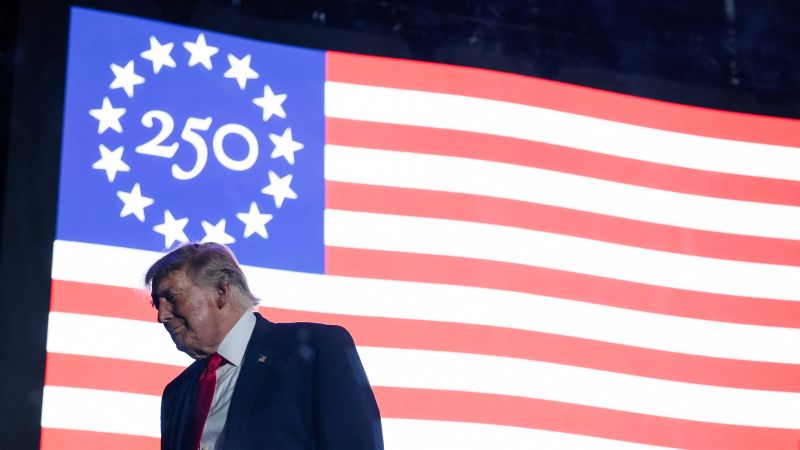
The disruption began in December when Trump unveiled an ambitious agenda for the nation’s 250th celebration through a video on his Truth Social platform. He promised a “celebration like no other,” emphasizing America’s glory and framing it as a public-private collaboration under the banner of Freedom 250. This announcement came weeks after Trump’s choice to lead the original America250 organization had been abruptly replaced, signaling his determination to reclaim control over the commemoration.
Trump’s Rebranding of National Memory
Freedom 250, a nonprofit under the National Park Foundation, was designed to align with Trump’s vision of patriotic pride. While it technically operates as a nonpartisan entity, its operations are heavily influenced by top Trump advisors. Unlike America250, which was overseen by a bipartisan panel, Freedom 250’s leadership is more closely tied to the White House. This shift has raised concerns about the organization’s independence and its ability to represent the broader American story.
Interior Secretary Doug Burgum described Freedom 250 as a project “run out of the White House,” with the authority to decide whether to disclose its donors. This control has sparked debates among watchdog groups and congressional Democrats, who question the transparency of the initiative. Richard Painter, a former ethics lawyer under George W. Bush, noted that the White House’s direct involvement with nonprofits without congressional approval could blur the lines between political influence and public celebration.
“Freedom 250 is a way for the administration to shape the narrative of this milestone,” said Linda Sarsour, a Next250 organizer known for her role in the Women’s March. “But the anniversary belongs to all of us—not just the president.” Her statement reflects the growing sentiment that the 250th celebration has become a battleground for political agendas rather than a shared moment of reflection.
Sponsors and the Hidden Hand
The list of Freedom 250’s sponsors reveals a web of connections to Trump’s allies and interests. Among the backers are Palantir, Lockheed Martin, and Oracle, all of which hold significant federal contracts. These companies, along with others like the Ultimate Fighting Championship and Penske Corp., are not just financial supporters but also participants in the anniversary’s programming. The UFC will host a fight on the White House lawn, while Penske’s IndyCar races will take place in August—a series of events that critics argue prioritize Trump’s image over the historical significance of the occasion.
Even the fair’s concessions reflect the political alignment. Trump’s Phorm energy drinks will be available for purchase, blending commerce with the ceremonial. This mix of corporate and political interests has led to accusations of the event being more about fundraising and ideological reinforcement than genuine celebration. “We’re all about accountability and transparency,” stated Freedom 250’s CEO, Keith Krach, in response to questions about donor disclosure. Yet, the organization’s close ties to the administration have left many skeptical about its commitment to neutrality.
A Split Nation, Two Celebrations
While the National Mall buzzes with Trump’s patriotic events, state and local planners across the country have opted to distance themselves from the capital’s approach. Some have chosen to hold independent commemorations, emphasizing inclusivity and diverse perspectives. This fragmentation has turned the 250th anniversary into a symbol of the nation’s divided identity, with different regions celebrating in ways that reflect their own values.
The original goal of the Next250 initiative—to unite communities and honor democracy—now seems overshadowed by the partisan fervor of Freedom 250. Critics argue that Trump’s vision reduces the anniversary to a tool for political messaging, sidelining the collaborative spirit that once defined it. “This country belongs to all of us,” Sarsour reiterated, as she and her team prepared to counter the White House’s narrative with their own grassroots celebration down the street.
The controversy surrounding the 250th anniversary is not just about who gets to host the events, but also about the legacy of the celebration itself. With Freedom 250 taking the lead, questions linger about whether the nation’s history will be told through a lens of unyielding patriotism or a more balanced, inclusive perspective. As the July 4 festivities approach, the split between these two visions serves as a reminder of how deeply political divides can shape even the most symbolic of national moments.
Freedom 250’s growing influence has also prompted a closer examination of its financial backers. The National Park Foundation confirmed that all funds received or spent by the organization during the fiscal year will undergo standard reporting and auditing. However, the presence of corporate sponsors with close ties to the Trump administration raises eyebrows. These partnerships, critics say, could ensure that the anniversary’s message aligns more with the president’s agenda than the collective memory of the American people.
Ultimately, the 250th birthday of the United States has become a microcosm of the broader political struggle. As one event celebrates unity, the other amplifies division, leaving the nation to wonder whether its founding ideals can still be honored in a time of heightened partisanship. The contrast between the two approaches underscores the challenge of maintaining a shared national narrative in an era where political power and influence are increasingly intertwined with the celebration of history.