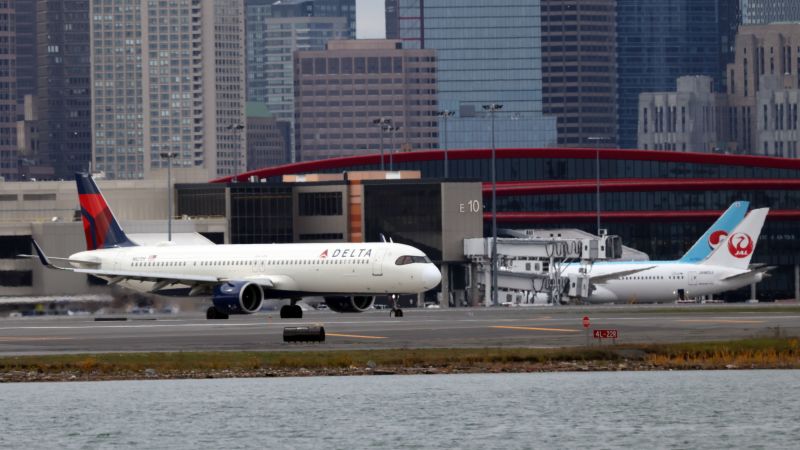
FAA investigates near-miss incident between two planes at Boston Logan International Airport
Sandego.net – A critical aviation incident occurred at Boston Logan International Airport on Saturday morning, prompting the Federal Aviation Administration (FAA) to initiate an investigation. According to flight tracking data, a Delta Air Lines flight and an American Airlines flight nearly collided during a routine operation at the airport’s intersecting runways. The Delta aircraft, Flight 2351, had to abort its landing attempt around 11:30 a.m. as the American Airlines flight, Flight 3161, accelerated for takeoff. The FAA is analyzing the event to determine if any safety protocols were breached or if additional measures are needed to prevent similar close calls in the future.
The situation unfolded when Delta’s pilots executed an evasive maneuver, known as a go-around, just before the Airbus A319 completed its landing. Passengers on the Delta flight reportedly deplaned without incident, as confirmed by a Delta spokesperson in a statement. The spokesperson emphasized that the go-around was a standard safety procedure, ensuring no harm was caused to the crew or travelers. However, the proximity of the two aircraft has raised concerns among aviation experts and raised questions about the efficiency of runway management at the busy hub.
Tracking data from Flightradar24, analyzed by CNN, shows the planes came within a few hundred feet of each other. This distance is close enough to cause alarm, though not severe enough to result in a collision. The incident occurred at a point where the Delta flight was on final approach and the American Airlines flight was preparing for takeoff. Such scenarios are common at airports with intersecting runways, where aircraft must coordinate their movements carefully. According to air traffic control audio from ATC.com, the American Airlines pilot was informed by the tower that the aircraft had been cleared for takeoff. The controller’s query about the flight’s progress highlights the need for precise communication between pilots and air traffic management.
While the FAA has not yet released findings, the incident has drawn attention to the challenges of managing overlapping runway operations. American Airlines has stated it will defer further inquiries to the FAA, which is leading the probe. This approach underscores the FAA’s role as the primary authority for aviation safety in the United States. The agency’s investigation will likely examine factors such as pilot decision-making, air traffic control instructions, and the aircraft’s adherence to standard operating procedures.
Understanding go-arounds and their significance in aviation safety
A go-around, or an aborted landing, is a critical safety maneuver in which a pilot decides to halt the landing process and initiate a climb to avoid potential hazards. This procedure is commonly used to prevent runway incursions—situations where aircraft, vehicles, or pedestrians are incorrectly positioned on a runway—and to address unexpected conditions like sudden wind shifts or unstable approaches. The Delta pilots’ decision to perform a go-around in this case demonstrates the proactive measures taken by flight crews to ensure passenger safety.
“Passengers aren’t told in advance it’s going to happen, but they’ll recognize it when suddenly they’re coming in to land and the aircraft just starts rising back up again,” said Michael McCormick, a former FAA air traffic manager and associate professor at Embry-Riddle Aeronautical University. McCormick, who has previously commented on aviation safety for CNN, added that go-arounds are an essential part of flight operations and are practiced regularly in training simulations.
McCormick’s insights emphasize that while go-arounds can be startling for passengers, they are a routine part of aviation. He noted that pilots are trained to handle such situations swiftly and efficiently, which minimizes risk. The recent incident at Boston Logan, however, has sparked renewed discussion about the frequency of these maneuvers and whether they indicate a broader trend in aviation safety.
Experts point to the growing number of similar incidents in the United States as a sign of systemic challenges in air traffic management. Over the past year, the FAA has reported an uptick in near-misses, particularly at high-traffic airports. These events are often attributed to factors like increasing air traffic, complex runway configurations, and human error. The FAA’s ongoing investigation into Saturday’s incident could provide valuable data to address these concerns.
Recent aviation incidents and their implications for safety
Amid this trend, the FAA is also examining a series of recent aviation-related incidents, including four notable plane crashes that have raised alarms about air safety. These crashes, while not directly linked to the Boston Logan event, contribute to a growing list of concerns that have prompted calls for enhanced oversight and training. Additionally, turbulence—both in the air and on the ground—has become a persistent issue for commercial aviation, with reports of more frequent and severe encounters.
Runway intersections, where the Delta and American flights were involved, are particularly high-risk areas. Pilots must rely on precise communication and real-time coordination to avoid conflicts. The FAA’s focus on these incidents reflects an effort to identify patterns and improve safety protocols. For example, the agency has been working on modernizing air traffic control systems to better manage high-density airspace and runway usage.
While the Delta and American Airlines incident did not result in damage or injuries, it serves as a reminder of the high stakes involved in aviation. According to industry data, go-arounds occur frequently in the U.S., with thousands of such maneuvers conducted daily. This frequency underscores their importance in preventing accidents and ensuring safe operations. However, the occurrence of multiple close calls in quick succession has led to speculation about whether procedural changes are necessary to reduce the risk of future incidents.
The FAA’s investigation will likely include a review of the specific circumstances surrounding Saturday’s event. Factors such as weather conditions, air traffic density, and the pilots’ responses will be scrutinized. This analysis is crucial for identifying whether the incident was an isolated occurrence or part of a larger trend. As the agency works to uncover the causes, the aviation community remains vigilant, with experts urging continued focus on safety training and technology upgrades to mitigate risks.
In the meantime, the incident has prompted renewed emphasis on the importance of clear communication between air traffic controllers and pilots. The controller’s question to the American Airlines pilot about the aircraft’s progress highlights how vital these interactions are in maintaining safe separations. Pilots, in turn, must relay accurate information to ensure that all parties are aware of their positions and intentions. This collaboration is essential in preventing conflicts, especially at busy airports with intersecting runways.
As the FAA continues its probe, the incident at Boston Logan International Airport serves as a case study for the complexities of modern aviation. With air traffic expected to grow in the coming years, the need for robust safety measures becomes even more pressing. The agency’s ability to address these challenges will be key to maintaining public confidence in air travel. For now, the event remains a critical point of discussion, reminding all stakeholders of the importance of vigilance and preparation in the skies.