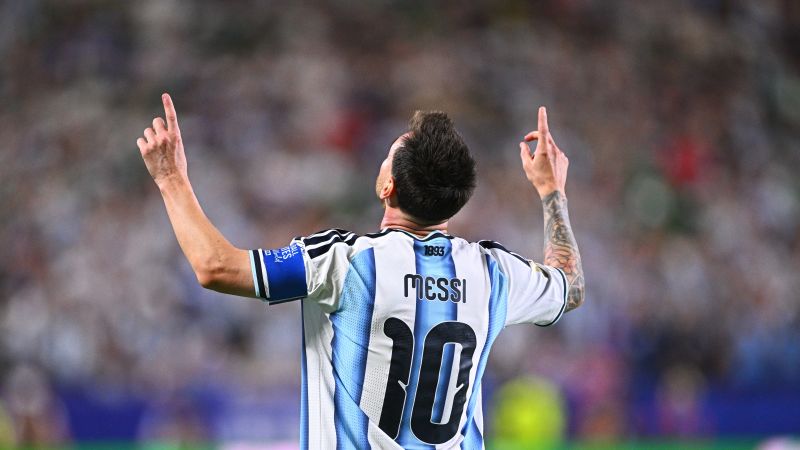
Lionel Messi Defies the Era with a World Cup Hat Trick: Still the Unbeatable Force
A Night of Resurgence
Sandego.net – On a night that promised a new chapter in global football, the 39-year-old Lionel Messi once again proved why he remains the undisputed standard-bearer of the sport. As young talents like Kylian Mbappé and Erling Haaland dazzled with their own historic performances, the narrative of a generational shift in soccer seemed inevitable. Mbappé, at 27, and Haaland, at 25, had already claimed the spotlight with their electrifying displays, and the World Cup’s final round of matches appeared poised to cement their status as the next great icons. Yet, in the heart of Kansas City, Messi delivered a masterclass that silenced the whispers of a changing era and reaffirmed his position as the sport’s ultimate legend.
Argentina’s match against Algeria began with high stakes and high hopes. The South American powerhouse, seeking a path to the final, faced a team brimming with youthful energy and determination. But from the outset, Messi’s influence was unmistakable. The Inter Miami star, known for his uncanny ability to create magic under pressure, seemed to command the field with an aura that transcended the physical limitations of his age. His first goal, though controversial, ignited the crowd and set the tone for a night that would be remembered as a testament to his enduring brilliance.
“MESSI SCORES ARGENTINA’S FIRST GOAL OF THE 2026 FIFA WORLD CUP!” ?? pic.twitter.com/JyNwqGCaFU
The first goal came in the blink of an eye, just six minutes into the game. Lautaro Martínez, positioned at the top of the box, received a pass and controlled the ball with his chest, effortlessly maneuvering it to his feet. To his left, Messi was a blur, slicing through the Algerian defense with a grace that belied his years. The moment he struck the ball, it was as if the stadium itself held its breath. The shot, a left-footed strike from close range, was a thing of beauty, looping past the keeper and into the back of the net. But the replay showed a critical detail: Messi had been slightly offside. If not for that technicality, the goal would have been his first of the tournament and the start of a remarkable scoring streak.
Despite the offside call, Messi’s impact was undeniable. His composure and precision, hallmarks of a player who has spent over two decades mastering the art of the beautiful game, were on full display. The 20-yard screamer he unleashed moments later was a perfect example of his ability to turn moments of pressure into moments of triumph. Receiving a through ball from the midfield, Messi dribbled toward the Algerian goal, pausing for a split second to assess the defenders closing in. With five opponents in his path, he executed a step-back, a half-turn, and a thunderous strike that deflected off the fingertips of Luca Zidane and nestled into the net. The goal, a blend of technical finesse and sheer audacity, was a defining moment of the match.
The Final Statement
As the first half progressed, Messi’s second goal arrived with a different kind of simplicity. The former Barcelona star, now playing for Argentina with a renewed intensity, demonstrated his ability to adapt and thrive in any situation. With the ball at his feet just outside the box, he unleashed a shot that was too strong for the Algerian goalkeeper to handle. The rebound was a gift, and Messi, with his trademark poise, pounced on it to extend Argentina’s lead. This goal, described as a “checkmate” by fans, highlighted his role as a clinical finisher even in the twilight of his career.
“IT’S A LIONEL MESSI BRACE IN THE 2026 FIFA WORLD CUP!” ?? pic.twitter.com/UySEduMBpo
The third goal, however, was the most poetic of all. It came in the 79th minute, as the game entered its final stretch. By this point, the Algerian defense appeared fatigued, their rhythm disrupted by Messi’s relentless pressure. A pass from Nico González on the wing was slightly behind him, but Messi, unmarked at the edge of the box, seized the opportunity. With a quick boot, he redirected the ball into the net, sealing his hat trick and tying the all-time World Cup scoring record with Miroslav Klose. The moment was a culmination of his influence throughout the match, a display of leadership that turned the tide in Argentina’s favor.
When Messi was substituted off, the Arrowhead Stadium crowd erupted in a standing ovation, a tribute to the man who had transformed the game in front of them. Thousands of fans had braved harsh traffic to witness this historic moment, and their anticipation was rewarded by a performance that defied the odds. The 16 goals across his World Cup career now placed him in a rare category, sharing the record with Klose and outpacing the young stars who had seemed poised to dethrone him. Yet, Messi’s achievements extend beyond numbers; he is also the youngest-ever player to score for Argentina in a World Cup match, a feat that underscores his timeless relevance.
The narrative of this tournament had been built on the emergence of new talent. Mbappé’s brace in the earlier match had showcased his full arsenal of skills, from his diagonal runs to his clinical finishing. Haaland’s two goals against Iraq had further signaled his potential to redefine the modern striker’s role. But in the face of such brilliance, Messi’s hat trick was not just a personal triumph—it was a statement. He proved that age is merely a number, that the heart of a legend beats just as strongly as ever, and that the World Cup is still a stage where his name resonates louder than any newcomer.
What made this performance so remarkable was the way Messi combined his youthful energy with the wisdom of a veteran. His first two goals, though different in execution, shared a common thread: an ability to create space where none existed. The third goal, on the other hand, was a product of the first two, as the Algerian defense, worn down by his relentless pressure, failed to recover. The crowd’s reaction, a mix of awe and disbelief, reflected the magnitude of the moment. Fans had waited for hours in the sweltering Kansas City heat, but the payoff was immediate and overwhelming.
As the final whistle blew, the tournament’s story took a twist. While Mbappé and Haaland had set the stage for a new era, Messi’s hat trick reminded the world that the old guard still has the power to shape it. His legacy, built on decades of dominance, was reaffirmed by a performance that blended the elegance of his early years with the grit of his current phase. In an age where speed and physicality often take center stage, Messi’s ability to manipulate the game with pure skill was a reminder of why he has been hailed as the greatest of all time.
For Argentina, Messi’s goals were more than just points on the scoreboard—they were a psychological weapon. The team, riding on his leadership, seemed unstoppable. Every pass, every dribble, and every shot was a calculated move, a testament to his experience and instincts. Even in the face of a motivated Algerian side, Messi’s influence was palpable, a force that could not be contained. The World Cup, often a stage for up-and-coming stars, became a celebration of his enduring dominance.
As the dust settled on this historic night, the facts were clear: Messi’s hat trick was not just a personal milestone but a defining moment in the World Cup’s narrative. He had once again outmaneuvered the competition, proving that while the world may have moved on, he remained the man who could control its direction. In a sport that celebrates innovation, Messi’s performance was a reminder that sometimes, the most iconic players are the ones who simply refuse to let go of the spotlight.