
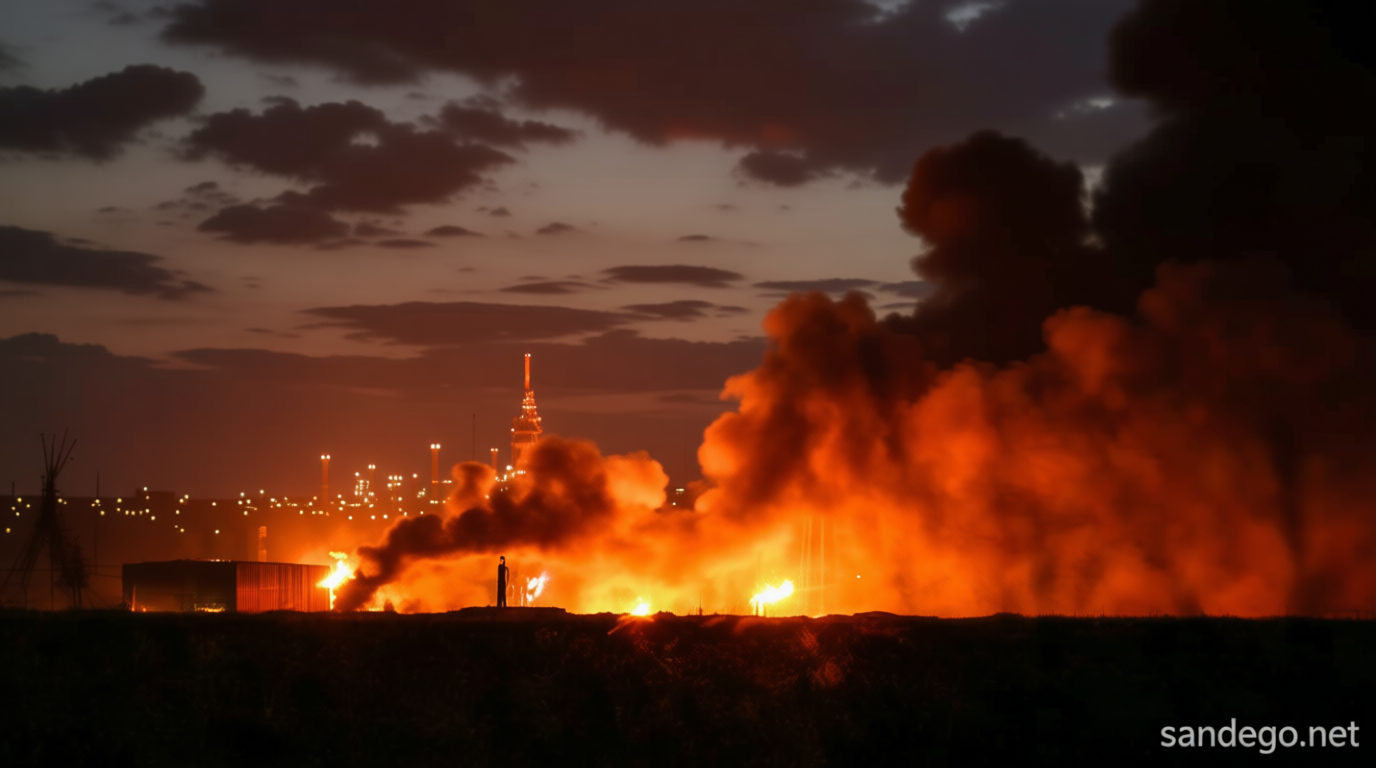
Blue Origin Rocket Explodes During Ground Test
Sandego.net – On Thursday, May 28, 2026, a Blue Origin New Glenn rocket encountered a technical issue during a ground test known as a hotfire at Cape Canaveral Space Force Station in Florida. Footage from the site later captured what appears to be the rocket detonating on its launchpad. The incident occurred around 9 p.m. local time, prompting immediate statements from the company and regulatory agencies. Despite the dramatic event, Blue Origin confirmed that all personnel involved were unharmed and accounted for.
Company Statements and Initial Reactions
Jeff Bezos, the founder of Blue Origin, shared a message on X, emphasizing the safety of the team. “All personnel are accounted for and safe,” he wrote. “It’s too early to know the root cause, but we’re already working to find it. Very rough day, but we’ll rebuild whatever needs rebuilding and get back to flying. It’s worth it.” The company had previously announced its intent to resume operations after a setback during the rocket’s third flight on April 19, which triggered an investigation by the Federal Aviation Administration (FAA).
“All personnel are accounted for and safe,” Jeff Bezos said on X.
The FAA released a statement confirming the anomaly and noting that the hotfire test was not part of its licensed activities. “The Blue Origin New Glenn vehicle experienced an anomaly during a static fire test on the pad in Cape Canaveral, Florida around 9 p.m. local time on May 28,” the agency noted. “There was no impact to air traffic. Please contact Blue Origin for more information.” The test, conducted at Launch Complex 36, left visible damage to the launchpad, though details about the extent of the harm remain undisclosed by Blue Origin.
NASA’s Acknowledgment and Broader Context
NASA chief Jared Isaacman also addressed the incident on X, stating, “NASA is aware of the anomaly that occurred tonight at Launch Complex 36 involving Blue Origin’s New Glenn rocket at Cape Canaveral Space Force Station.” He highlighted the challenges of developing heavy-lift launch systems, noting that spaceflight is inherently risky. “Spaceflight is unforgiving, and developing new heavy-lift launch capability is extraordinarily difficult,” Isaacman remarked. “We will work with our partners to support a thorough investigation of this anomaly, assess near-term mission impacts, and get back to launching rockets.”
According to a statement from the US Space Force, range officials are collaborating with Blue Origin and its partners to pinpoint the exact cause of the anomaly. The Eastern Range, which supports critical testing and training activities, often involves experimental technologies and developmental systems. These operations, while essential for advancing national security and space capabilities, carry inherent risks, including unexpected failures during trials.
Debris Warning and Environmental Concerns
Blue Origin issued a social media alert on Friday, warning that debris from the explosion might reach coastal areas in the coming days. “If you encounter any debris, do not touch or approach it for your safety,” the company urged. This precaution underscores the potential environmental and logistical impacts of the incident, particularly given the proximity of the launch site to the ocean.
The New Glenn rocket, Blue Origin’s first orbital launch vehicle, has faced several milestones and challenges since its inception. Its debut flight on January 16, 2025, was declared a success, though the company fell short of its goal to recover the first-stage booster after launch. The failure to reignite engines during the landing attempt was later cited as the reason for this setback. This maneuver, which aims to allow reuse of rocket components akin to SpaceX’s Falcon rockets, is designed to reduce costs and improve efficiency.
Previous Missions and Developmental Progress
Following the January 2025 launch, Blue Origin spent ten months refining the New Glenn rocket to ensure a reliable booster landing. The second test flight in November 2025 reportedly proceeded without incident, with the first stage successfully touching down on a seafaring platform. The mission also carried a pivotal NASA payload, the Escapade mission, which marked a significant step in interplanetary exploration. The third flight in April 2026, though successful in landing the booster, ended in disappointment due to the loss of AST SpaceMobile’s BlueBird 7 satellite.
Blue Origin’s CEO, Dave Limp, acknowledged this outcome in a post on X. “While we are pleased with the nominal booster recovery, we clearly didn’t deliver the mission our customer wanted,” he wrote. The company’s goal for the fourth flight was to deploy 48 satellites to Amazon’s Leo broadband constellation, a project aiming to provide global internet coverage. The explosion during the hotfire test has now delayed these plans, though the company remains committed to resuming operations.
“Spaceflight is unforgiving, and developing new heavy-lift launch capability is extraordinarily difficult,” NASA chief Jared Isaacman said on X.
Industry Implications and Future Prospects
For Blue Origin, the incident raises questions about the reliability of its New Glenn rocket and its ability to compete with SpaceX in the rapidly evolving commercial space industry. The company’s strategy of reusing boosters is a key component of its long-term vision, which seeks to reduce launch costs and increase mission frequency. If New Glenn can achieve consistent success with this approach, it may challenge SpaceX’s dominance in the sector.
The fourth mission, originally scheduled to test the rocket’s performance in carrying a large satellite constellation, was a crucial step toward proving the vehicle’s capabilities. The explosion during the hotfire test highlights the complexities of testing advanced rocket systems, particularly in the context of developing new technologies. While the FAA and NASA have stated that the anomaly did not affect air traffic or national security, the incident serves as a reminder of the risks involved in pushing the boundaries of space exploration.
Blue Origin has not yet provided detailed information about the cause of the anomaly, but the company’s swift response and focus on recovery suggest a determination to move forward. The incident, though a setback, is part of the broader journey to establish a robust and reusable launch system. As the space industry continues to grow, such events underscore the importance of perseverance and innovation in overcoming technical hurdles.
Broader Impact on the Space Race
The New Glenn rocket’s explosion during the hotfire test could have ripple effects beyond Blue Origin’s immediate operations. It highlights the challenges of developing next-generation launch vehicles and the need for continued investment in research and development. The company’s efforts to refine the New Glenn system are part of a larger trend in the space sector, where private firms are racing to create more efficient and cost-effective technologies.
With the potential for anomalies during testing, Blue Origin and its partners must balance speed with safety. The US Space Force’s role in coordinating the investigation emphasizes the collaboration between private companies and government agencies in advancing space capabilities. As the company works to determine the root cause of the incident, its ability to adapt and innovate will be critical to its future success in the competitive space industry.
In the wake of the explosion, Blue Origin has reiterated its confidence in the New Glenn program. “We will rebuild whatever needs rebuilding and get back to flying,” Bezos emphasized. The incident, while a setback, serves as a testament to the challenges of space exploration and the resilience required to overcome them. As the company prepares for the next phase of testing, its commitment to advancing the field of space travel remains unchanged.