
Tragic BASE Jump Incident Claims Lives in Utah Canyon
Sandego.net – A weekend BASE jumping accident in a remote Utah canyon claimed the lives of two individuals, one of whom was the renowned extreme athlete Andy Lewis. Known for his daring feats and global stardom, Lewis was a prominent figure in the world of extreme sports, yet his death underscores the inherent risks of the activity he loved. The Grand County Sheriff’s Office confirmed the incident, with Lewis identified as one of the victims. The tragedy occurred at Mineral Bottom, a desert area straddling the Utah-Colorado border, where emergency responders were called to the scene after a report of an accident during a jump.
A Life Defined by Risk and Innovation
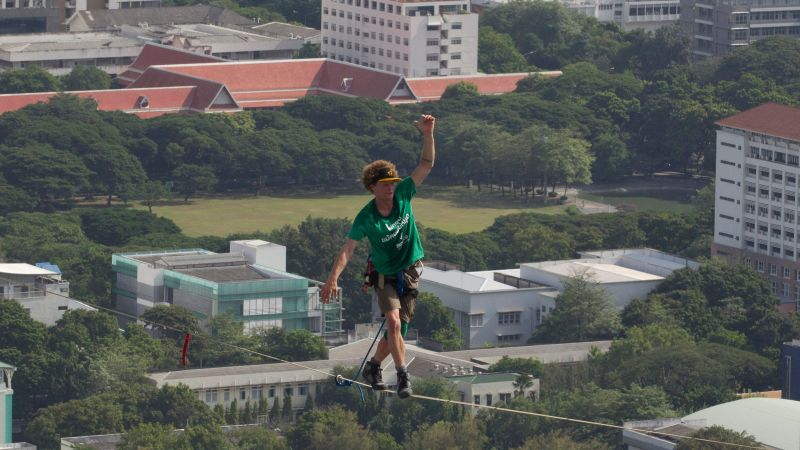
Andy Lewis’s career was marked by a fearless approach to adventure. While he gained fame for his role in Madonna’s 2012 Super Bowl halftime show, where he performed acrobatic tricks on an inch-wide slackline in a Roman toga, his true legacy lay in the extreme sport of BASE jumping. This discipline, which involves leaping from fixed objects like buildings, bridges, or canyon edges and deploying a parachute for a controlled descent, required not only physical prowess but also a deep understanding of risk management. Lewis was celebrated for his audacity, often executing jumps that others hesitated to attempt, as noted by John McEvoy, a BASE jumping instructor in Twin Falls, Idaho, who has collaborated with Lewis on multiple occasions.
“He had an incredible level of athleticism and skill developed over years of practice,” McEvoy remarked. “But then he would take an incredible amount of risk.” This duality defined Lewis’s approach to the sport. His willingness to push boundaries extended beyond BASE jumping into other high-risk activities, such as slacklining and tricklining. These sports blend the elegance of high-wire walking with the thrill of aerial acrobatics, often performed at extreme heights. Lewis’s mastery of these disciplines earned him recognition, including four consecutive world championships in competitive slacklining from 2008 to 2011.
From Super Bowl Stunts to Desert Canyons
Lewis’s transition from a relatively obscure athlete to an international celebrity began during his performance in Madonna’s 2012 Super Bowl halftime show. Dressed in a Roman toga, he demonstrated incredible balance and agility by bouncing on a narrow slackline, mimicking the fluidity of surfing. The spectacle captivated millions, and Lewis became a symbol of the intersection between mainstream entertainment and extreme sports. On Conan O’Brien’s late-night show, he humorously remarked, “My phone actually rang itself to death three days in a row,” highlighting the attention his act brought.
However, Lewis’s passion for adventure was not confined to the spotlight. His work in BASE jumping and other niche sports often took place in isolated locations, such as the rugged canyons of Utah. The accident at Mineral Bottom, a desolate desert area, exemplifies the challenges of these environments. Despite the remoteness of the site, the incident was captured by emergency teams who arrived swiftly to assess the situation. According to the sheriff’s release, both Lewis and an unidentified 50-year-old man were found dead at the scene, though the specifics of the jump remain under investigation.
BASE Jumping: A Sport of Thrills and Dangers
BASE jumping, while thrilling for enthusiasts, carries significant risks. The sport’s name itself is an acronym: Building, Antenna, Span, and Earth. Unlike traditional skydiving, BASE jumpers often leap from closer objects, such as cliffs or bridges, which reduces the time for deployment and increases the likelihood of miscalculations. A study published in a medical journal in 2007 estimated that BASE jumping involves risks five to eight times greater than skydiving, emphasizing the potential for catastrophic outcomes.
Although no official tally exists for BASE jumping fatalities, the website BASEaddict.com maintains a comprehensive list of 540 global deaths since 1981. This includes 30 fatalities from the previous year alone, with notable names like Dean Potter and his climbing partner Graham Hunt, who perished during a wingsuit flight in Yosemite National Park in 2015. Lewis himself acknowledged the sport’s peril, speaking with documentary filmmaker Ella Warnick in an interview published last year. “It’s weird to think about how many people are dead, because it’s like a normal thing,” he said, reflecting on the sport’s growing popularity and the associated dangers.
The Controversy of Tandem BASE Jumps
While Lewis’s death occurred during an unspecified jump, the sheriff’s spokesperson, Lt. Al Cymbaluk, noted that the incident might have involved a tandem BASE jump. These jumps pair an experienced instructor with a less seasoned participant, with both individuals attached to a single parachute. According to McEvoy, tandem jumps are both a source of debate and a method of introducing newcomers to the sport. “Within BASE, it’s a very controversial topic,” he said. “There’s a lot of people who say it’s the stupidest thing in the world and others arguing: `No, we’re giving people the experience of their lives.’”
BASE Jump Moab, Lewis’s business, specialized in tandem excursions, offering an accessible entry point for beginners. However, the controversy surrounding tandem jumps persists, with critics arguing that the shared parachute system increases the risk of accidents, particularly when one jumper is less experienced. Lewis’s own business likely served as a testament to his belief in the sport’s potential to inspire, even as it posed life-threatening challenges. The absence of immediate responses to contact attempts from BASE Jump Moab following the accident suggests a sense of shock and reflection within the community.
Throughout his career, Lewis set numerous records, including a Guinness World Record for slackline surfing. This feat involved swaying his feet side to side in a rocking motion, akin to riding a wave, while suspended above China’s Diaoshuilou waterfall. His ability to perform such intricate maneuvers at extreme altitudes, such as walking a slackline between two hot air balloons over 4,000 feet above the Nevada desert in 2014, further cemented his reputation as a pioneer in his field. Yet, even as he achieved these milestones, the risk of disaster loomed large.
The tragedy at Mineral Bottom serves as a poignant reminder of the fine line between thrill-seeking and danger. As investigations continue, the community reflects on Lewis’s contributions and the legacy he left behind. His death not only affects his loved ones but also highlights the ongoing discourse within BASE jumping about safety, innovation, and the price of pushing limits. For those who followed his career, the loss is a stark reminder that even the most skilled athletes are not immune to the sport’s unpredictable nature.